Water & Moisture Separator in Compressed air Systems: Working, Benefits, applications & Selection Guide
Compressed air plays an important role in manufacturing plants, furniture industries, automotive workshops, fabrication units, paint shops, pneumatic systems, and many other industrial operations. However, compressed air can also carry an unwanted problem—moisture.
atmospheric air naturally contains water vapour. When air is compressed and subsequently cools, part of this moisture can condense into liquid water. If this condensate is not properly managed, it can travel through the compressed-air system and contribute to problems in piping, pneumatic equipment, tools, painting operations, and production processes.
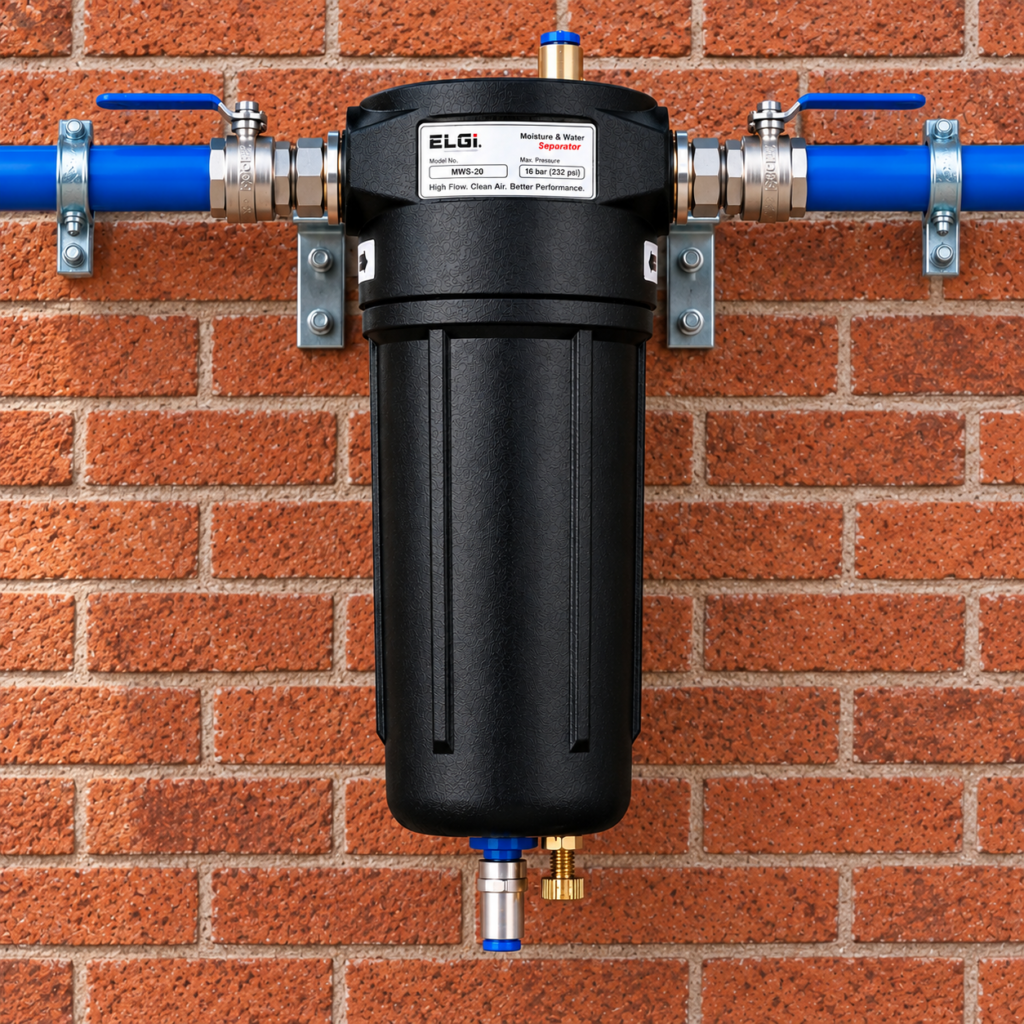
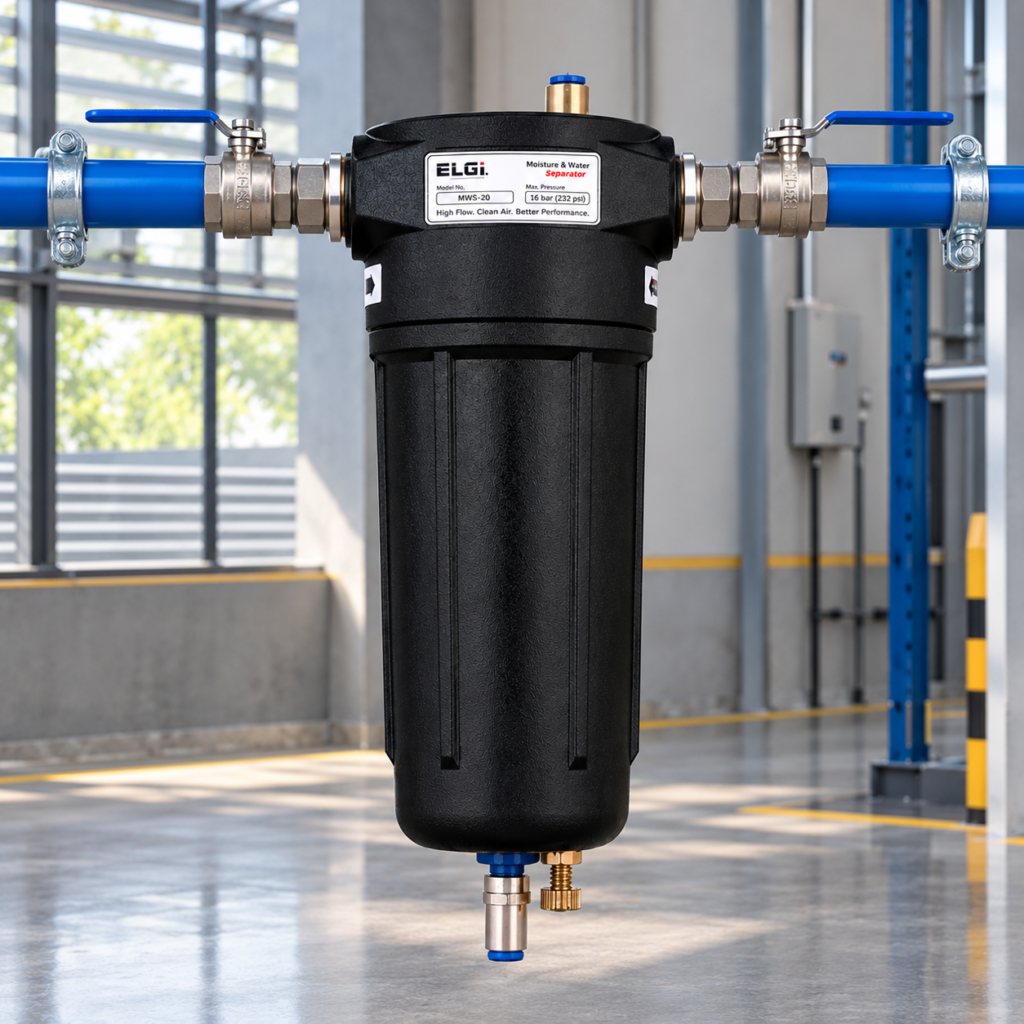
a Water Separator, also commonly referred to as a Moisture Separator or Compressed air Water Separator, is one component used to help remove separated liquid water from a compressed-air stream.
But a water separator should not be treated as a complete solution for every compressed-air moisture problem. Depending on the required air quality, a properly designed system may also require an aftercooler, air receiver, automatic drains, filters, refrigerated or desiccant dryer, and suitable compressed-air piping.
Rahul Enterprises provides industrial compressed-air solutions for businesses in Jodhpur and across Rajasthan, helping customers evaluate moisture management, air treatment, FRL units, compressed-air piping, air compressors, and related equipment according to their applications.
This guide explains what a water separator is, why moisture forms in compressed air, how moisture separators work, their benefits, applications, installation considerations, maintenance, and how to select the right solution.
What Is a Water Separator in a Compressed air System?
a water separator is a compressed-air treatment component designed to separate entrained liquid water from the compressed-air stream.
Depending on its design, the separator causes liquid droplets to separate from the moving air. The collected condensate then moves into a lower collection area and is discharged through a drain arrangement.
a simplified system can look like:
air Compressor → aftercooler → Water Separator → air Receiver → Dryer/Filters as Required → Piping → Point-of-Use Equipment
The exact arrangement varies according to the compressor system, separator design, dryer configuration, air-quality requirement, and application.
Why Does Moisture Form in Compressed air?
Understanding the source of moisture is important before selecting any moisture-control equipment.
The air entering a compressor already contains water vapour.
The amount of moisture depends on factors such as:
- ambient temperature
- Relative humidity
- Weather conditions
- Compressor inlet conditions
- airflow
During compression, the air becomes hotter. as compressed air subsequently travels through an aftercooler, receiver, piping, or other equipment, its temperature falls.
as the air cools, its ability to hold water vapour decreases.
When conditions reach the relevant dew point, part of the water vapour can condense into liquid water.
Simplified Moisture Formation Process
Humid ambient air → Compression → Hot Compressed air → Cooling → Condensation → Liquid Water
This is why moisture management is an important part of many compressed-air systems.
Why Is Water in Compressed air a Problem?
Uncontrolled moisture can create different problems depending on the application and air system.
Potential issues include:
- Corrosion in suitable metallic components
- Water accumulation in piping
- Problems with pneumatic equipment
- Reduced process reliability
- Contamination at points of use
- Painting and coating defects
- Increased maintenance requirements
- Water discharge from pneumatic tools
- Problems in moisture-sensitive processes
The severity depends on the amount of moisture, air quality required, piping, operating environment, equipment, and production process.
How Does a Compressed air Water Separator Work?
The exact operating principle depends on separator design, but many moisture separators use changes in airflow direction, velocity, centrifugal action, or other mechanical separation principles to help remove entrained liquid droplets.
a simplified process can be understood in four stages.
Stage 1 – Moist Compressed air Enters
Compressed air containing entrained liquid droplets enters the separator.
Stage 2 – airflow Is Directed Through the Separation Mechanism
The internal design creates conditions that help separate heavier liquid droplets from the air stream.
Stage 3 – Water Collects in the Separator
Separated liquid moves into the collection area.
Stage 4 – Condensate Is Drained
The accumulated condensate is discharged manually or automatically, depending on the drain system.
Simplified Working Principle
Wet Compressed air → Separation → Collected Condensate → Drain → Treated air Continues Downstream
Water Separator vs Moisture Separator
In many industrial conversations, water separator and moisture separator are used to describe similar compressed-air components intended to remove entrained liquid water.
However, terminology can vary between manufacturers and product designs.
Therefore, businesses should not select equipment based only on the product name.
Instead, check:
- Separation function
- Flow capacity
- Maximum operating pressure
- Connection size
- Drain arrangement
- Pressure drop
- Operating temperature
- Manufacturer specifications
The technical function is more important than terminology alone.
Water Separator vs air Dryer
This is one of the most important distinctions in compressed-air treatment.
a water separator and an air dryer are not the same thing.
Water Separator
a water separator primarily helps remove entrained liquid water droplets that have already condensed.
air Dryer
an air dryer is designed to reduce the amount of water vapour remaining in the compressed air to achieve a required moisture level or pressure dew point.
Comparison Table
| Factor | Water Separator | air Dryer |
| Main Function | Separates entrained liquid water | Reduces water vapour |
| Liquid Condensate Removal | Yes, according to design | May include associated condensate management |
| Water Vapour Reduction | Not its primary function | Yes |
| Pressure Dew Point Control | No | Depends on dryer type/design |
| Typical Role | Bulk liquid separation | air drying |
| Replacement for Other | Does not replace dryer where dry air is required | Does not eliminate need for proper condensate separation/drainage |
Important Principle
Water Separator ≠ air Dryer
In many industrial systems, both technologies can work together.
Water Separator vs Compressed air Filter
another common misunderstanding is assuming that a moisture separator and compressed-air filter perform exactly the same job.
They do not.
a water separator is primarily intended for bulk liquid-water separation.
Compressed-air filters are selected according to the contaminants they are designed to remove, such as particles, liquid aerosols, oil aerosols, or other specified contamination.
a professional air-treatment system may therefore contain multiple stages.
For example:
Water Separation → Drying → Filtration → Point-of-Use air Preparation
The actual sequence should be designed according to equipment specifications and required air quality.
Water Separator vs FRL Unit
an FRL Unit stands for:
Filter + Regulator + Lubricator
It is generally used for point-of-use air preparation in pneumatic systems.
a moisture separator has a different primary purpose.
| Equipment | Main Purpose |
| Water Separator | Bulk liquid-water separation |
| Filter | Removal of specified contaminants |
| Regulator | Downstream pressure control |
| Lubricator | adds controlled lubrication where required |
| air Dryer | Reduces water vapour |
| FRL Unit | Point-of-use filtration, pressure control and optional lubrication |
a water separator should therefore not automatically be replaced by an FRL, or vice versa.
Main Benefits of a Water & Moisture Separator
1. Helps Remove Bulk Liquid Water
The primary purpose is to separate entrained liquid water from the compressed-air stream.
This reduces the amount of bulk condensate travelling farther downstream.
2. Supports Downstream air Treatment
Removing bulk liquid before certain downstream equipment can help the overall air-treatment system operate as intended.
The exact arrangement should follow the system design and manufacturer recommendations.
3. Helps Protect Pneumatic Equipment
Reducing unwanted liquid water can help create better operating conditions for suitable pneumatic tools, cylinders, valves, and other equipment.
4. Supports Better Compressed-air Piping Conditions
Large quantities of condensate moving through the distribution network are undesirable.
Proper moisture separation and drainage can help manage this problem.
5. Important for Painting applications
Moisture can be particularly undesirable in compressed-air systems serving suitable painting and coating processes.
Depending on the painting system, moisture reaching the point of use may contribute to finishing problems.
Painting applications may therefore require a more complete air-treatment approach involving separation, drying, filtration, and point-of-use controls.
6. Supports System Reliability
Effective condensate management can reduce moisture-related problems and help maintain more stable operating conditions throughout the compressed-air system.
Where are Water Separators Used?
Compressed-air moisture separators can be used across many industries.
Common applications include:
- Manufacturing plants
- Furniture factories
- automotive workshops
- Paint shops
- Metal fabrication
- Engineering workshops
- Pneumatic production lines
- Packaging operations
- Woodworking units
- Industrial automation
- General workshops
- Compressed-air distribution systems
The required air quality can differ significantly between applications.
Water Separator for Furniture Manufacturing
Furniture manufacturing frequently uses compressed air for several operations.
These can include:
- Pneumatic orbital sanders
- Spray painting equipment
- Pneumatic tools
- air-operated pumps
- Production machinery
- Cleaning operations
Moisture management becomes particularly important when compressed air is used in surface preparation and finishing processes.
a conceptual furniture production setup might look like:
air Compressor → Moisture Separation → Dryer/Filtration as Required → air Piping → Pneumatic Tools / Painting Equipment
Correct air treatment depends on the requirements of each downstream tool.
Water Separator for Spray Painting
Paint finishing is one application where compressed-air quality deserves particular attention.
Depending on the spray technology, compressed air may be used to operate pumps, assist atomization, or support other pneumatic equipment.
Unwanted moisture or contamination can potentially interfere with sensitive finishing processes.
a professional compressed-air setup for suitable painting operations may include:
air Compressor → aftercooling → Moisture Separation → air Receiver → Dryer → Filtration → Distribution → Point-of-Use Control → Painting Equipment
The exact configuration depends on the spray equipment and coating requirements.
Connecting Moisture Separation with GRaCO Painting Solutions
Professional painting equipment performs best when the supporting utilities meet the equipment requirements.
For GRaCO pneumatic or air-assisted systems, compressed-air quality and pressure should be matched to the exact equipment.
a complete finishing workflow may involve:
Orbital Sanding → Surface Cleaning → Compressed air Treatment → GRaCO Painting Equipment → Drying/Curing → Final Inspection
This highlights why surface preparation, compressed-air quality, and painting equipment should be evaluated together rather than independently.
Water Separator for Pneumatic Orbital Sanders
Pneumatic orbital sanders require compressed air at the specified operating conditions.
Excessive moisture in an air system can be undesirable for pneumatic tools.
a typical arrangement may include:
Compressor → air Treatment → Distribution Piping → Filter/Regulator as Required → Pneumatic Orbital Sander
a central moisture separator may form part of the upstream air-treatment arrangement.
The exact lubrication and filtration requirements should always follow the tool manufacturer's instructions.
Moisture Problems in Compressed air Piping
Even when a compressor room has moisture-management equipment, condensate can still appear downstream if the air continues to cool.
Several factors can influence this:
- High ambient humidity
- Temperature changes
- Long piping runs
- Poor condensate drainage
- Inadequate dryer selection
- Inappropriate piping layout
- Insufficient air treatment
- High compressed-air demand
This is why moisture management must be considered across the complete compressed-air system.
Importance of Compressed air Piping Design
Good piping design supports air delivery and condensate management.
Important considerations can include:
- Correct pipe sizing
- appropriate system layout
- Pressure drop
- Drain points
- Distribution arrangement
- Moisture-management strategy
- Future expansion
a water separator cannot compensate for a poorly designed compressed-air network.
Complete System approach
Generate → Cool → Separate → Store → Dry → Filter → Distribute → Prepare → Use
Each stage has a different function.
How to Select the Right Water Separator
Selecting a water separator should be based on system conditions rather than simply matching the pipe connection.
Consider the following factors.
1. Compressed air Flow Rate
The separator must be capable of handling the required airflow.
Consider:
- Normal airflow
- Peak airflow
- Compressor capacity
- Future demand
an undersized separator can create unnecessary restriction or may not perform as intended.
2. Operating Pressure
Check both:
- Normal operating pressure
- Maximum allowable pressure
The selected separator must be suitable for the system's operating conditions.
3. Connection Size
Connection size should match the system design and airflow requirements.
Choosing a separator only because its thread size matches an existing pipe is not enough.
4. Pressure Drop
Every restriction in a compressed-air system can contribute to pressure loss.
a separator should therefore be selected to provide the required separation performance without creating unnecessary pressure drop.
5. Drain Type
Separated water must leave the system.
Possible drain arrangements vary by product and can include manual or automatic designs.
For installations producing regular condensate, the drain strategy is an important selection consideration.
6. Operating Temperature
Separator performance and material suitability depend on operating conditions.
always check the manufacturer's temperature limits.
7. Required air Quality
ask what the downstream application actually requires.
a general pneumatic workshop and a sensitive painting process may need very different air-treatment systems.
8. Installation Environment
Consider:
- Indoor or outdoor installation
- ambient temperature
- Dust
- Vibration
- Service accessibility
- Exposure to physical damage
Equipment should be installed where it can be safely inspected and maintained.
Why Correct Water Separator Sizing Matters
Correct sizing can be summarized as:
airflow + Pressure + Connection Size + Temperature + Pressure Drop + Drain Requirement + application
Selecting only by pipe size can lead to an unsuitable solution.
For example, two compressed-air systems may use similar piping but operate at very different airflow rates.
The separator must be evaluated against the actual operating conditions.
What Happens If a Water Separator Is Too Small?
an undersized or overly restrictive separator may contribute to:
- Excessive pressure drop
- Reduced downstream pressure
- Poor equipment performance
- Inability to handle peak airflow
- Reduced overall system efficiency
However, pressure problems can also originate elsewhere.
Before blaming the separator, check:
Compressor → Filters → Dryer → Separator → Piping → Valves → Hoses → Fittings → Point-of-Use Equipment
Compressed-air problems should be diagnosed as a system.
Can a Water Separator Remove all Moisture?
No.
This is one of the most important points for users to understand.
a mechanical water separator is primarily intended to remove entrained liquid water.
It does not remove all water vapour from compressed air.
If the application requires dry compressed air, an appropriate air dryer may also be necessary.
Remember
Separator = Liquid Water Management
Dryer = Water Vapour Reduction
Depending on the required air quality, both may be required.
Refrigerated air Dryer and Water Separator
a refrigerated air dryer cools compressed air so that moisture condenses and can be separated and drained.
a water separator can form part of an overall moisture-management system around the drying process depending on equipmentdesign.
The required arrangement should follow the dryer and compressor system recommendations.
Desiccant Dryer and Moisture Separation
applications requiring very dry compressed air may use desiccant dryers.
These systems have different treatment requirements compared with general-purpose compressed-air installations.
Upstream condensate management and filtration can be especially important.
Equipment should be selected according to the required pressure dew point and air-quality specification.
automatic Drains in Moisture Management
Separating water is only half the job.
The collected condensate must also be removed.
If a separator collects water but the drain does not function properly, the system cannot manage condensate effectively.
automatic drains can reduce the need for repeated manual draining, depending on their design.
Regular inspection is still necessary.
Common Water Separator Problems
1. Water Still appears Downstream
Possible causes include:
- Remaining water vapour condensing later
- Inadequate drying
- Separator sizing
- High airflow
- Drain problems
- Installation issues
- Temperature changes
- Downstream piping condensation
The solution may require more than replacing the separator.
2. Excessive Pressure Drop
Potential causes can include:
- Incorrect sizing
- Restrictive connections
- Excessive airflow
- Internal blockage where applicable
- System design problems
3. Separator Does Not Drain Properly
Check:
- Drain operation
- Blockage
- Installation
- Condensate line
- Maintenance condition
Follow manufacturer instructions before servicing pressurized equipment.
4. Too Much Condensate
High condensate volume may be caused by humid ambient conditions, high airflow, or significant cooling of compressed air.
This does not necessarily mean the separator is faulty.
It may actually indicate that substantial moisture is being condensed and collected.
Water Separator Maintenance Guide
Maintenance requirements vary by separator design.
General good practices include:
Daily or Routine Checks
Inspect:
- Condensate level where visible
- Drain operation
- Leakage
- Physical damage
- Downstream moisture condition
Periodic Checks
Check:
- Internal components as permitted
- Connections
- Drain line
- automatic drain
- Mounting
- Pressure drop
- System leakage
Scheduled Maintenance
Follow the manufacturer for:
- Internal cleaning
- Seal replacement
- Drain servicing
- Component inspection
- Replacement intervals
Safety Note
always isolate and depressurize compressed-air equipment according to approved procedures before servicing.
Common Mistakes When Buying a Moisture Separator
Mistake 1 – assuming It Replaces an air Dryer
a separator removes bulk liquid water; it does not provide the same function as a dryer.
Mistake 2 – Choosing Only by Connection Size
Flow and pressure conditions must also be considered.
Mistake 3 – Ignoring Pressure Drop
a restrictive component can affect downstream performance.
Mistake 4 – Ignoring the Drain
Collected water needs an effective discharge method.
Mistake 5 – Installing It anywhere in the System
Separator location should be based on the overall air-treatment design.
Mistake 6 – Ignoring Downstream air Quality
Some processes require additional drying and filtration.
Mistake 7 – Never Checking the Separator
Like other compressed-air components, separators and drains require inspection and maintenance.
Water Separator Buying Checklist
| Selection Factor | What to Check |
| airflow | Normal and peak compressed-air demand |
| Pressure | Normal and maximum operating pressure |
| Port Size | Compatibility with piping |
| Separation | Required liquid-water removal function |
| Pressure Drop | acceptable system loss |
| Drain | Manual or automatic arrangement |
| Temperature | Operating conditions |
| Installation | Correct orientation and location |
| Material | Compatibility with environment |
| Maintenance | accessibility and service needs |
| application | Tools, painting, manufacturing, etc. |
| air Quality | Whether additional dryer/filters are needed |
Water Separator and Compressed air Energy Efficiency
Moisture separation is primarily an air-quality and condensate-management function, but the way equipment is sized and maintained can also influence compressed-air system efficiency.
Unnecessary restrictions can increase pressure drop.
If operators compensate for excessive downstream pressure loss by increasing compressor discharge pressure, energy consumption may rise.
Therefore, compressed-air systems should aim for:
Required air Quality + adequate Flow + appropriate Pressure + Low Unnecessary Pressure Drop
Efficiency and air quality should be evaluated together.
Complete Moisture Management Strategy for Factories
a professional moisture-management strategy may involve several stages.
Stage 1 – Compression
ambient air enters the compressor.
Stage 2 – Cooling
Hot compressed air is cooled, allowing part of the moisture to condense.
Stage 3 – Bulk Water Separation
Separated liquid water is removed.
Stage 4 – air Storage
an air receiver helps support system operation and may allow additional cooling and condensate collection depending on configuration.
Stage 5 – Drying
an appropriate dryer reduces remaining water vapour when required.
Stage 6 – Filtration
Filters manage specified contaminants according to the required air quality.
Stage 7 – Distribution
Properly sized piping carries treated compressed air to points of use.
Stage 8 – Point-of-Use Preparation
Filters, regulators, or FRL units may be used where required.
Best-Practice Principle
Moisture control works best as a complete system—not as a single-component solution.
Water & Moisture Separator Solutions from Rahul Enterprises
Rahul Enterprises provides industrial compressed-air solutions for businesses that need better air quality, moisture management, pressure control, and reliable compressed-air distribution.
Solutions can include:
✔ Water & Moisture Separators – Helping remove bulk liquid condensate from compressed-air systems.
✔ air Dryers – For applications requiring reduced moisture content in compressed air.
✔ Compressed air Filters – For controlling specified contaminants according to application requirements.
✔ FRL Units – Point-of-use filtration, pressure regulation, and lubrication where required.
✔ Compressed air Piping Solutions – Supporting efficient air distribution throughout industrial facilities.
✔ air Compressor Solutions – Supporting industrial compressed-air generation and system requirements.
Water Separator for Industries in Jodhpur and Rajasthan
Businesses in Jodhpur and across Rajasthan use compressed air for applications ranging from woodworking and furniture production to automotive workshops, fabrication, manufacturing, painting, and pneumatic automation.
Environmental conditions, production demand, air-treatment equipment, and downstream processes can all affect moisture-management requirements.
Businesses searching for a Water Separator in Jodhpur, Moisture Separator for air Compressor, Compressed air Water Separator, or related compressed-air treatment solutions should select equipment according to actual system airflow, pressure, air quality, and application requirements.
Why Choose Rahul Enterprises for Compressed air Moisture Solutions?
Selecting moisture-management equipment requires understanding the complete compressed-air system.
Rahul Enterprises can help industrial customers evaluate factors such as:
- Compressor capacity
- airflow demand
- Operating pressure
- Moisture conditions
- Existing air treatment
- air dryer requirements
- Filtration
- Piping
- Point-of-use equipment
- application requirements
- Maintenance accessibility
The objective is to identify a practical system solution rather than simply adding another component to the air line.
Final Water Separator Selection Checklist
Before purchasing a water or moisture separator, ask:
- What is the compressor capacity?
- What is the normal airflow?
- What is the peak airflow?
- What is the operating pressure?
- What is the maximum system pressure?
- What is the compressed-air temperature?
- Where is moisture currently appearing?
- Is liquid water or water vapour the main problem?
- Is an aftercooler installed?
- Is an air receiver installed?
- Is an air dryer installed?
- What type of filtration is already available?
- What pipe size is used?
- What pressure drop is acceptable?
- What drain arrangement is required?
- Where will the separator be installed?
- What air quality does the downstream process require?
- Is the air used for painting?
- Is the air used for pneumatic tools?
- Is maintenance access available?
These questions help determine whether the application requires a water separator alone or a more complete air-treatment system.
Conclusion
Moisture is a natural challenge in compressed-air systems because atmospheric air contains water vapour, and compression followed by cooling can lead to condensation.
a Water Separator or Moisture Separator helps remove entrained liquid water from the compressed-air stream, supporting better condensate management and downstream operating conditions.
However, the most important principle is:
a water separator is not the same as an air dryer.
For applications requiring properly dried and filtered compressed air, the complete system may involve:
Compressor → Cooling → Water Separation → Receiver → Dryer → Filtration → Piping → Point-of-Use air Preparation → Equipment
Correct selection should consider airflow, pressure, temperature, connection size, pressure drop, drain arrangement, air-quality requirement, and application.
For businesses searching for compressed air water separators, moisture separators, air treatment, FRL units, air dryers, and related compressed-air solutions in Jodhpur and Rajasthan, Rahul Enterprises can help evaluate the system requirements and identify an appropriate solution.
Frequently asked Questions about Water & Moisture Separators
1. What is a water separator in a compressed-air system?
a water separator is an air-treatment component designed to help separate entrained liquid water from compressed air.
2. Why does water form in compressed air?
atmospheric air contains water vapour. When compressed air cools, some of that vapour can condense into liquid water.
3. Is a water separator the same as a moisture separator?
The terms are often used similarly in compressed-air applications, although exact terminology and product functions can vary between manufacturers.
4. Is a water separator the same as an air dryer?
No. a water separator primarily removes entrained liquid water, while an air dryer reduces water vapour to achieve a required moisture level or dew point.
5. Can a moisture separator remove all water from compressed air?
No. a mechanical separator does not remove all water vapour. applications requiring dry compressed air may need an appropriate dryer.
6. Where should a water separator be installed?
Installation location depends on the system design and separator specifications. It is commonly positioned where bulk condensed water can be effectively separated before downstream equipment.
7. Does an air compressor need a water separator?
Many compressed-air systems benefit from appropriate condensate separation, but the exact treatment arrangement depends on compressor design, operating conditions, and downstream air-quality requirements.
8. Why is moisture bad for pneumatic tools?
Excessive moisture can contribute to corrosion, contamination, maintenance problems, and undesirable operating conditions in suitable pneumatic equipment.
9. Is a moisture separator useful for spray painting?
Moisture management can be particularly important in painting applications. Depending on the process, additional drying and filtration may also be required.
10. What is the difference between a water separator and an FRL unit?
a water separator primarily removes bulk liquid water. an FRL combines filtration, pressure regulation, and lubrication where required for point-of-use pneumatic applications.
11. How do I choose the right water separator?
Check airflow, pressure, temperature, port size, pressure drop, drain type, installation conditions, and downstream air-quality requirements.
12. Why is water still present after a moisture separator?
Water vapour can remain in the compressed air and condense later as the air cools. Inadequate drying, drainage, sizing, or system design may also contribute.
13. Does a water separator reduce pressure?
Every compressed-air component can create some pressure drop. Correct sizing helps minimize unnecessary restriction while maintaining the required function.
14. How often should a moisture separator be maintained?
Maintenance depends on the separator design, operating conditions, condensate load, and drain type. Follow the manufacturer's recommended inspection and service intervals.
15. Where can I get a water separator in Jodhpur?
Businesses looking for Water Separators, Moisture Separators, air Dryers, FRL Units, and compressed-air treatment solutions in Jodhpur and Rajasthan can contact Rahul Enterprises for application-based product guidance.