Jindal Compressed air Piping System: Benefits, applications, Installation & Selection Guide
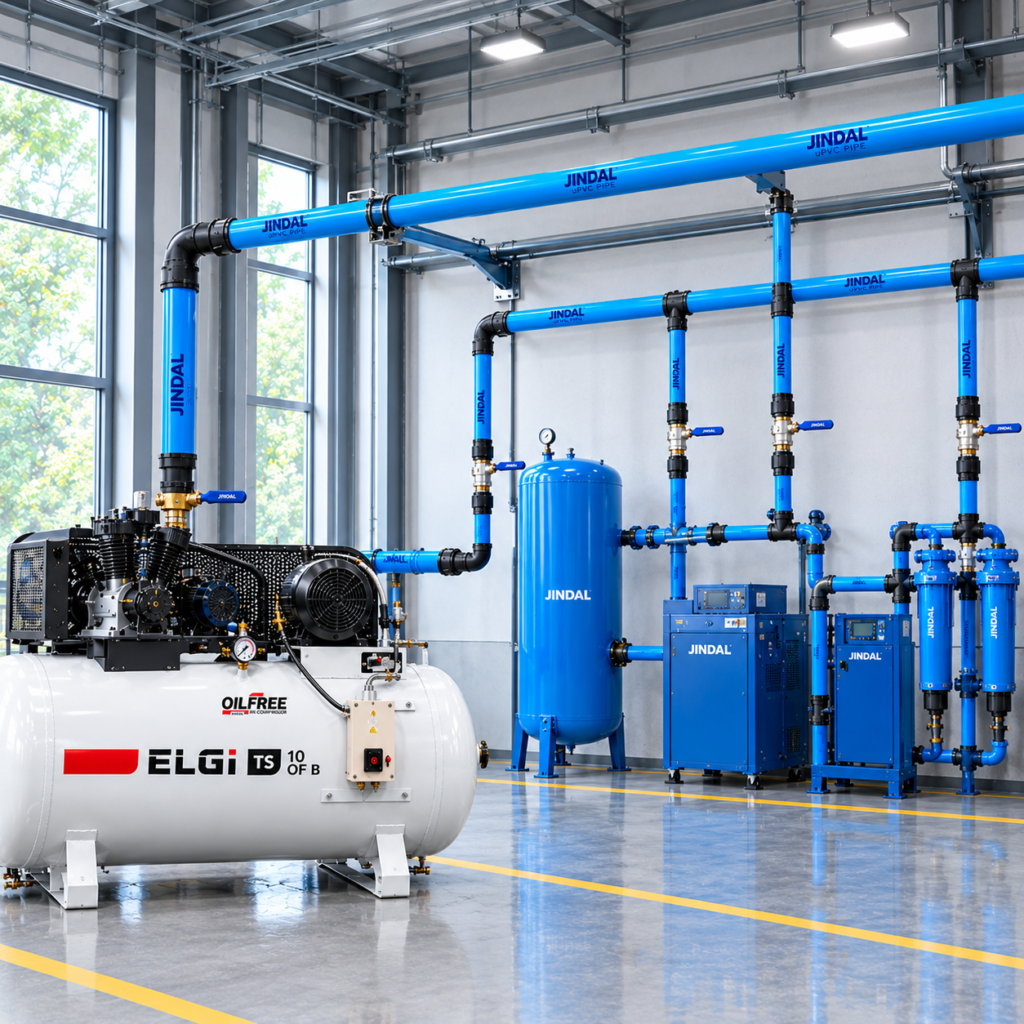
a reliable air compressor is only one part of an efficient compressed-air system. Once compressed air is generated and treated, it must travel through the facility and reach pneumatic tools, machines, painting equipment, production lines, and other points of use at the required pressure and flow.
This is where the compressed air piping system becomes extremely important.
Poorly planned piping can contribute to pressure drop, air leakage, inefficient distribution, moisture-related problems, and poor performance at the point of use. Even a properly selected air compressor may not deliver the expected results if the distribution network is restrictive, incorrectly sized, or poorly maintained.
a professionally planned Jindal compressed air piping solution can support efficient compressed-air distribution across factories, workshops, furniture manufacturing units, automotive facilities, fabrication plants, and other industrial environments.
Rahul Enterprises provides compressed-air and industrial solutions for businesses in Jodhpur and across Rajasthan, including Jindal air piping solutions for suitable industrial compressed-air applications.
This complete guide explains compressed air piping, its importance, piping layouts, pressure drop, pipe sizing, installation, moisture management, applications, maintenance, and how to select an appropriate Jindal air piping solution for your facility.
What Is a Compressed air Piping System?
a compressed air piping system is the distribution network that carries compressed air from the compressor room to different points of use throughout an industrial facility.
a complete compressed-air system can be represented as:
air Compressor → air Receiver → air Treatment → Main air Piping → Branch Lines → Point-of-Use air Preparation → Pneumatic Equipment
Depending on the application, air-treatment equipment may include:
- Water or moisture separator
- air dryer
- Compressed-air filters
- Condensate drains
- FR or FRL units
- Pressure regulators
The piping system connects these components with the equipment that actually consumes compressed air.
Why Is Compressed air Piping Important?
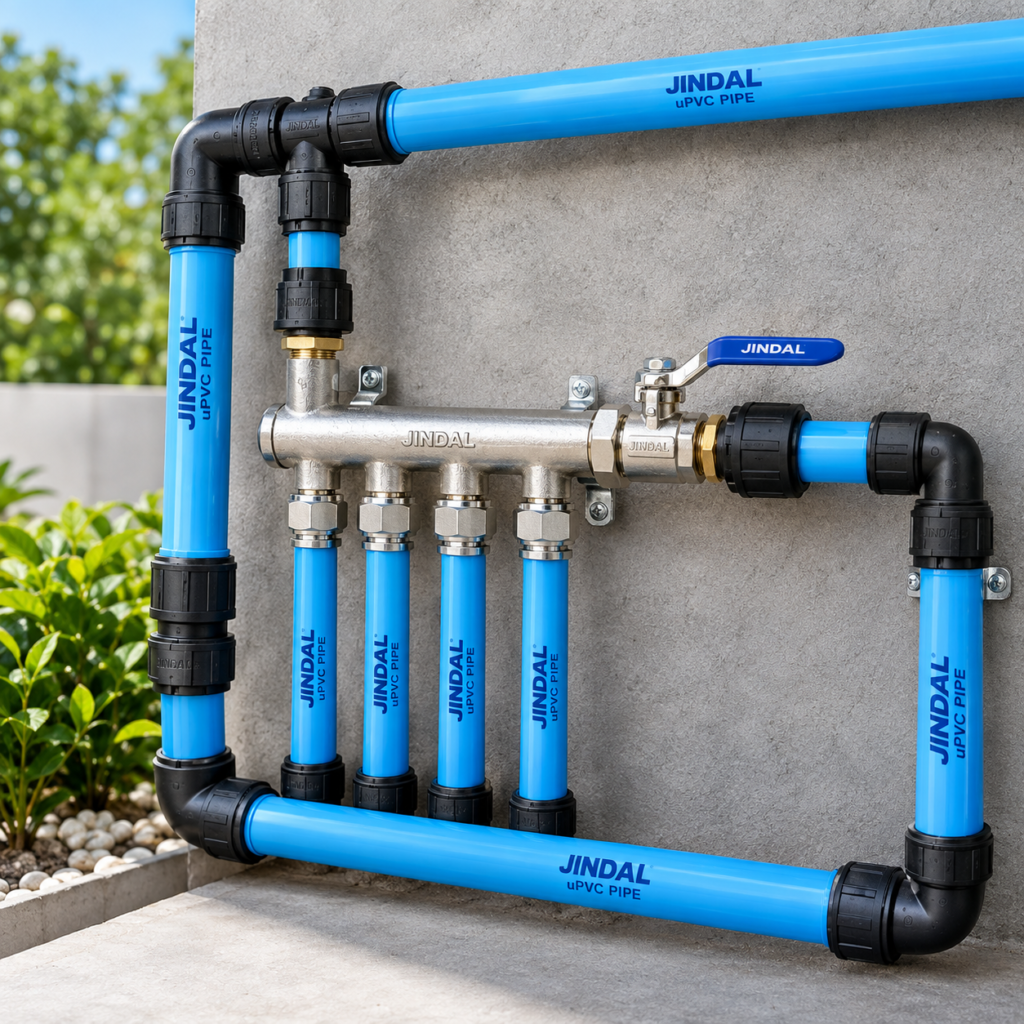
Many businesses focus heavily on compressor capacity but pay less attention to how compressed air reaches production equipment.
This can be a costly mistake.
a compressed-air distribution network should be designed to deliver the required:
airflow + Pressure + air Quality
If piping is undersized or poorly configured, the system may experience unnecessary resistance.
Potential consequences include:
- Excessive pressure drop
- Poor pneumatic-tool performance
- Slow cylinder operation
- Unstable equipment pressure
- Difficulty meeting peak demand
- Increased leakage risk at poor connections
- Moisture-management problems
- Higher operating costs
For this reason, compressed-air piping should be considered during initial system design rather than treated as an afterthought.
Understanding Jindal air Piping Solutions
Jindal air piping solutions can be considered as part of an industrial compressed-air distribution network where appropriate.
The objective of an industrial air piping system is straightforward:
Move the required volume of compressed air from the compressor system to points of use with acceptable pressure loss and reliable distribution.
However, achieving this requires careful consideration of pipe diameter, layout, total length, airflow, operating pressure, fittings, branch connections, future expansion, and air-treatment requirements.
How Does a Compressed air Piping System Work?
Once air is compressed, it travels through several stages before reaching production equipment.
Stage 1 – air Generation
The air compressor generates compressed air.
Stage 2 – Storage
an air receiver can provide storage and help support system stability.
Stage 3 – air Treatment
Depending on the required air quality, compressed air may pass through separators, dryers, and filters.
Stage 4 – Main Distribution
The main compressed-air piping carries air throughout the facility.
Stage 5 – Branch Distribution
Branch lines supply individual production areas or equipment.
Stage 6 – Point-of-Use Preparation
Filters, regulators, or FRL units may be installed where required.
Stage 7 – Final application
Compressed air reaches:
- Pneumatic tools
- Cylinders
- Valves
- Orbital sanders
- Painting equipment
- Production machinery
- automation equipment
Complete Flow
Generate → Store → Treat → Distribute → Regulate → Use
What Is Pressure Drop in Compressed air Piping?
Pressure drop is the reduction in pressure that occurs as compressed air travels through the distribution system.
Some pressure loss is unavoidable, but excessive pressure drop is undesirable.
Pressure loss can occur across:
- Pipes
- Fittings
- Valves
- Filters
- Dryers
- Separators
- Hoses
- Couplings
- Point-of-use components
The objective is to design the complete system so that equipment receives adequate pressure during actual operation.
What Causes Excessive Pressure Drop?
Several factors can contribute to excessive pressure loss.
1. Undersized Piping
If the pipe diameter is too small for the required airflow, air velocity and resistance can increase.
This can create significant pressure loss, particularly across longer piping runs.
2. Long Pipe Runs
Pressure losses accumulate as compressed air travels through piping.
Longer distances therefore need to be considered during sizing.
3. Too Many Bends and Fittings
Elbows, tees, valves, reducers, couplings, and other components add resistance.
a poorly planned layout with unnecessary restrictions can increase total pressure drop.
4. Restricted Filters or air-Treatment Components
The piping itself may not always be responsible.
Dirty filters, incorrectly sized dryers, restrictive separators, hoses, and fittings can also contribute to pressure loss.
5. Excessive air Demand
If production demand exceeds the capacity of the compressor or distribution network, pressure can fall during peak operation.
6. air Leakage
Leaks waste compressed air and can contribute to difficulty maintaining the required pressure at points of use.
Why Correct Pipe Sizing Is Important
Pipe diameter is one of the most important compressed-air distribution decisions.
The correct size depends on multiple variables:
airflow + Pipe Length + Operating Pressure + allowable Pressure Drop + Fittings + Future Demand
Choosing pipe size based only on the compressor outlet connection is not a reliable design method.
a compressor may have a particular outlet size, while the facility's main distribution line may need different sizing based on total airflow and distance.
What Happens If Compressed air Piping Is Too Small?
Undersized piping can contribute to:
- High air velocity
- Excessive pressure drop
- Poor downstream equipment performance
- Unstable production pressure
- Difficulty supplying simultaneous users
- Higher system losses
Operators may respond by increasing compressor pressure.
However, increasing compressor discharge pressure to compensate for a restrictive distribution network can increase energy consumption.
The better solution is to identify and correct the actual restriction where practical.
Can Compressed air Piping Be Too Large?
Larger piping can reduce velocity and pressure loss, but unnecessarily oversized piping can increase initial investment and installation requirements.
The goal should therefore be appropriate sizing, not simply installing the largest possible pipe.
a well-designed system balances:
Performance + Pressure Drop + Installation Cost + Future Expansion
Different Compressed air Piping Layouts
Facility layout has a major influence on compressed-air distribution.
Two common approaches are dead-end and ring-main distribution.
Dead-End Compressed air Piping
In a simple dead-end system, compressed air travels from the source along a main line that terminates at the far end.
Conceptually:
Compressor → Main Line → Point a → Point B → Point C
This arrangement may be appropriate for some smaller or simpler installations.
However, pressure at distant points can be more sensitive to demand and piping restrictions.
Ring Main Compressed air Piping
a ring-main system forms a loop around the production area.
Conceptually:
Compressor → Main Ring → Multiple Branches → Production Equipment
air can potentially reach demand points through different directions within the loop.
For many larger facilities, an appropriately designed ring network can support more balanced air distribution and future branch additions.
Ring Main vs Dead-End Piping
| Factor | Ring Main | Dead-End |
| Distribution | Multiple flow paths possible | Primarily one direction |
| Large Facility Suitability | Often useful | application-dependent |
| Expansion | Can be flexible | Depends on layout |
| Pressure Distribution | Can support more balanced delivery | Far-end losses require attention |
| Initial Installation | More extensive | Usually simpler |
| Best Choice | Production networks with multiple users | Smaller/simple layouts where suitable |
Neither layout should be selected without considering the actual factory arrangement and demand.
Jindal air Piping for Manufacturing Plants
Manufacturing plants can have many compressed-air users operating simultaneously.
These may include:
- Pneumatic cylinders
- air tools
- assembly machines
- Packaging equipment
- automation
- Valves
- Painting systems
- Material-handling equipment
The piping network must support not only average demand but also realistic peak and simultaneous demand.
a well-planned distribution system should therefore consider both current production and reasonable future expansion.
Jindal air Piping for Furniture Manufacturing
Furniture manufacturing is a good example of an industry where compressed air can support several production stages.
Compressed air may be used for:
- Pneumatic orbital sanders
- Spray equipment
- air-operated pumps
- Nailers and staplers
- Pneumatic tools
- Production machinery
- Cleaning operations
a conceptual furniture manufacturing system may look like:
ELGi air Compressor → Moisture Management → air Dryer/Filters → Jindal air Piping → FR/FRL → Orbital Sander / GRaCO Painting Equipment / Pneumatic Tools
Each stage should be matched to the equipment requirements.
Jindal air Piping for Painting applications
Painting applications can require careful attention to both compressed-air pressure and air quality.
a piping system serving painting equipment should be designed to deliver the required airflow without excessive pressure loss.
at the same time, appropriate moisture and contamination control may be necessary.
a professional setup can involve:
Compressor → Receiver → Water Separator → Dryer → Filters → Jindal air Piping → Point-of-Use Control → Painting Equipment
The exact air-treatment requirements depend on the painting technology and coating process.
Connecting Jindal Piping with GRaCO Painting Solutions
GRaCO air-operated pumps or air-assisted painting systems may require a reliable compressed-air supply.
If the distribution piping is restrictive, equipment performance can be affected even when the compressor itself has sufficient capacity.
This is why painting-system planning should consider:
Compressor Capacity → air Quality → Piping Capacity → Point-of-Use Pressure → Equipment Requirement
The complete system matters.
Jindal air Piping for Pneumatic Orbital Sanders
Professional pneumatic orbital sanders can consume a significant amount of compressed air during operation, depending on the tool.
If several sanders operate simultaneously, the combined airflow requirement can become substantial.
For example, the correct planning process should consider:
Number of Sanders × actual Tool air Demand × Simultaneous Usage
The distribution system must then be capable of supplying that demand at the required pressure.
Connecting Jindal air Piping with FRL Units
FRL units are generally installed closer to pneumatic equipment where point-of-use air preparation is required.
The piping network carries treated compressed air to that location.
a typical arrangement can be:
Main air Piping → Branch Line → Isolation Valve → FR/FRL → Hose → Pneumatic Equipment
The FRL should also be correctly sized so it does not become a restriction.
Moisture Management in Compressed air Piping
Water can become a major issue in compressed-air distribution.
Even after compression, moisture may continue to condense as air cools.
Potential consequences include:
- Water collecting in low points
- Corrosion in susceptible components
- Water reaching pneumatic tools
- Painting problems
- Maintenance issues
a complete moisture-management strategy may include:
Cooling → Separation → Drainage → Drying → Filtration → appropriate Piping Design
a piping system alone cannot replace proper air treatment.
Why Water Separators Matter Before air Distribution
a water or moisture separator can help remove bulk liquid condensate from compressed air.
This can reduce the amount of liquid water entering downstream treatment and distribution.
However:
Water Separator ≠ air Dryer
a separator removes entrained liquid water according to its design, while a dryer reduces water vapour to meet a required moisture level.
Depending on the application, both may be required.
Importance of Drain Points in Compressed air Systems
Condensate needs a planned method of removal.
Poorly designed systems may allow water to accumulate in undesirable locations.
Depending on the piping design and air-treatment arrangement, suitable drain points may be required.
Drain selection and placement should be based on the actual system configuration and manufacturer recommendations.
How air Leaks affect a Jindal Compressed air Piping System
Compressed-air leakage represents wasted air that the compressor has already consumed energy to produce.
Common leak locations can include:
- Connections
- Couplings
- Flexible hoses
- Valves
- Point-of-use fittings
- Pneumatic equipment
Regular leak inspection should therefore be part of compressed-air maintenance.
a good piping network should be installed correctly and inspected periodically.
How Piping Can affect air Compressor Energy Consumption
The compressor must generate enough pressure to overcome system losses and still satisfy the point-of-use requirement.
Suppose production equipment requires a particular pressure, but the distribution network creates excessive pressure loss.
Operators may increase compressor discharge pressure to compensate.
This can increase energy consumption.
a more efficient strategy is to reduce unnecessary pressure losses through:
- Correct pipe sizing
- Efficient layout
- appropriate fittings
- Clean filters
- Correctly sized air-treatment equipment
- Leak management
- Proper maintenance
Efficiency Principle
Required Point-of-Use Pressure + Minimum Practical Distribution Loss = Better System Efficiency
How to Select the Right Jindal air Piping System
Compressed-air piping should be selected according to actual system requirements.
Consider the following factors.
1. Compressor Capacity
Know the compressor's airflow capability and operating pressure.
The piping network must support the required air delivery.
2. Total air Demand
Calculate the demand of all relevant equipment.
Examples include:
- Sanders
- Spray equipment
- Pneumatic cylinders
- air tools
- Pumps
- Production machines
Consider simultaneous use rather than simply adding every machine's maximum demand without understanding the operating pattern.
3. Main Pipe Length
Longer piping networks require more careful pressure-drop evaluation.
4. Required Operating Pressure
Determine the actual pressure required at the equipment.
Do not design solely around the compressor's maximum available pressure.
5. allowable Pressure Drop
The distribution system should be designed so that equipment receives sufficient pressure during operation.
6. Number of Branches
Consider how many production areas and individual users require compressed air.
7. Future Expansion
Factories change.
New machines, additional production lines, and additional pneumatic tools can increase air demand.
Reasonable future capacity should therefore be considered during initial planning.
8. air Quality
Different applications may require different air quality.
For example, general pneumatic tools and sensitive painting processes may not have identical requirements.
9. Installation Environment
Consider:
- Indoor or outdoor routing
- Temperature
- Physical protection
- accessibility
- Maintenance
- Production layout
Compressed air Piping Design Checklist
Before finalizing the piping system, evaluate:
| Design Factor | What to Check |
| Compressor | Capacity and pressure |
| air Demand | Normal and peak usage |
| Pipe Size | Required flow and distance |
| Pipe Length | Total distribution distance |
| Layout | Ring main or other suitable configuration |
| Pressure Drop | acceptable loss |
| Branches | Number and location |
| air Quality | application requirements |
| Moisture | Separation, drying and drainage |
| Fittings | Minimize unnecessary restrictions |
| Valves | Isolation and maintenance requirements |
| Point of Use | Required pressure and flow |
| Expansion | Future production demand |
| Maintenance | accessibility |
| Leakage | Connection quality and inspection |
Planning a New Factory Compressed air Network
For a new facility, compressed-air distribution should ideally be planned alongside the production layout.
a practical process is:
Step 1 – Map all Compressed-air Users
Identify every machine and tool requiring air.
Step 2 – Determine air Demand
Record airflow and pressure requirements.
Step 3 – Estimate Simultaneous Demand
Understand which equipment operates at the same time.
Step 4 – Plan Compressor Room Location
Consider distribution distance and air-treatment requirements.
Step 5 – Select Main Piping Layout
Determine whether a ring main or another configuration is appropriate.
Step 6 – Size Main and Branch Lines
Calculate based on airflow, pressure, distance, and acceptable pressure drop.
Step 7 – Plan air Treatment
Include separators, dryers, filters, and drains where required.
Step 8 – Plan Future Connections
allow practical provisions for expected expansion.
Complete Design Principle
Compressor + air Treatment + Piping + Point-of-Use Preparation + Equipment Demand should be designed as one compressed-air system.
Common Compressed air Piping Mistakes
Mistake 1 – Selecting Pipe Size Only from Compressor Outlet
The complete airflow and distribution length must be considered.
Mistake 2 – Installing Undersized Piping
This can create excessive pressure loss.
Mistake 3 – Using Too Many Restrictive Fittings
Every unnecessary restriction can contribute to system losses.
Mistake 4 – Ignoring Future Expansion
a network that works today may become restrictive after new equipment is added.
Mistake 5 – Ignoring Moisture
Piping and moisture management should be considered together.
Mistake 6 – Increasing Compressor Pressure Instead of Fixing Restrictions
Higher pressure can increase operating cost without solving the underlying distribution problem.
Mistake 7 – Ignoring air Leaks
Even a properly sized network loses efficiency when connections and downstream equipment leak.
Mistake 8 – Ignoring Point-of-Use Requirements
The pressure at the compressor is less important than whether the machine receives the required pressure and airflow during operation.
Maintenance of a Compressed air Piping System
a compressed-air network should be inspected periodically.
Important maintenance activities include:
Check for air Leaks
Inspect connections, valves, hoses, and fittings.
Check System Pressure
Compare pressure at key points, particularly during production demand.
Inspect Condensate Management
Ensure drains and moisture-management equipment operate correctly.
Inspect Physical Condition
Check piping, supports, valves, and connections for damage or deterioration.
Review Production Changes
If new machines have been added, reassess whether the existing network still meets airflow requirements.
Troubleshooting Common Compressed air Distribution Problems
| Problem | Possible Causes |
| Low pressure at machine | Undersized piping, leaks, restriction, high demand |
| Pressure drops during production | Peak demand, insufficient compressor/piping capacity |
| Water at point of use | Inadequate separation/drying/drainage or downstream condensation |
| Pneumatic tools run slowly | Low pressure, insufficient airflow, restrictive hose/FRL/piping |
| Compressor runs excessively | Leaks, increased demand, control/system issues |
| Painting equipment performs inconsistently | Pressure, airflow, air quality or equipment setup |
| One production area has low pressure | Branch sizing, local restriction or demand imbalance |
a proper diagnosis should evaluate the entire compressed-air system.
Jindal air Piping as Part of a Complete Industrial Solution
Compressed-air piping should not be treated as an isolated product.
a complete industrial system may involve:
✔ ELGi air Compressors – Generating compressed air for industrial applications.
✔ Water & Moisture Separators – Supporting bulk condensate removal.
✔ air Dryers & Filters – Helping achieve the required compressed-air quality.
✔ Jindal air Piping Solutions – Distributing compressed air throughout the facility.
✔ FRL Units – Point-of-use air preparation for suitable pneumatic applications.
✔ Pneumatic Orbital Sanders – Professional surface-preparation tools.
✔ GRaCO Painting Solutions – Professional coating and fluid-handling equipment.
This integrated approach helps businesses evaluate the entire production process instead of purchasing individual components without considering how they interact.
Jindal air Piping Solutions from Rahul Enterprises
Rahul Enterprises provides industrial solutions for compressed-air and production applications in Jodhpur and across Rajasthan.
For businesses planning a new compressed-air network or improving an existing system, important factors include:
- Compressor capacity
- air demand
- Piping layout
- Pipe sizing
- Pressure drop
- air quality
- Moisture management
- Branch connections
- Point-of-use requirements
- Future expansion
The objective is to create a compressed-air distribution solution that supports the actual production requirement.
Jindal Compressed air Piping in Jodhpur and Rajasthan
Industrial businesses in Jodhpur and across Rajasthan may require compressed-air piping for:
- Furniture manufacturing
- Handicraft production
- automotive workshops
- Fabrication units
- Engineering plants
- Manufacturing facilities
- Paint shops
- Packaging units
- Pneumatic automation
- General industrial workshops
Businesses searching for Jindal air Piping in Jodhpur, Compressed air Piping System, Industrial air Piping, or Compressed air Piping Solutions in Rajasthan can contact Rahul Enterprises to discuss their facility and compressed-air requirements.
Why Choose Rahul Enterprises for Jindal air Piping Solutions?
Compressed-air piping selection requires more than simply choosing a pipe diameter.
Rahul Enterprises can help customers evaluate the wider system requirements, including:
- Existing compressor capacity
- Required airflow
- Operating pressure
- Production layout
- Pipe distance
- Point-of-use demand
- air treatment
- Moisture management
- FRL requirements
- Pneumatic equipment
- Future expansion
This application-based approach can help businesses plan a more practical compressed-air distribution network.
Final Jindal air Piping Selection Checklist
Before planning or purchasing a compressed-air piping system, determine:
- What is the compressor capacity?
- What is the operating pressure?
- What is the total compressed-air demand?
- What is the peak demand?
- Which machines operate simultaneously?
- What pressure is required at each point of use?
- How long is the main piping run?
- How many branches are required?
- What pipe diameter is appropriate?
- What pressure drop is acceptable?
- Would a ring-main layout be appropriate?
- What air treatment is required?
- How will condensate be managed?
- Where will isolation valves be installed?
- What point-of-use filtration or regulation is required?
- are pneumatic sanders being used?
- Is compressed air used for painting?
- are new machines likely to be added?
- Is the system accessible for maintenance?
- Is there a plan for periodic leak inspection?
Conclusion
a compressed air piping system is one of the most important parts of an industrial compressed-air installation.
The compressor may generate the air, but the piping network determines how effectively that air reaches machines, pneumatic tools, painting equipment, and production lines.
Poor piping design can contribute to:
Pressure Drop + Restricted airflow + Poor Equipment Performance + air Leakage + Higher Operating Costs
a properly planned Jindal compressed air piping system should consider:
airflow → Pressure → Pipe Size → Distance → Layout → Pressure Drop → air Quality → Moisture Management → Future Demand
Businesses should avoid selecting piping only according to compressor outlet size or initial cost.
Instead, the compressor, air treatment, distribution piping, and downstream equipment should be evaluated as one complete system.
For businesses looking for Jindal compressed air piping solutions in Jodhpur and Rajasthan, Rahul Enterprises can help evaluate industrial compressed-air distribution requirements for furniture factories, automotive workshops, manufacturing plants, fabrication units, paint shops, and other industrial applications.
Frequently asked Questions about Jindal Compressed air Piping
1. What is a compressed air piping system?
a compressed-air piping system is the distribution network that carries compressed air from the compressor and air-treatment equipment to different points of use throughout a facility.
2. Why is compressed air pipe sizing important?
Correct pipe sizing helps provide the required airflow while controlling unnecessary pressure loss across the distribution network.
3. What causes pressure drop in compressed air piping?
Pressure drop can result from undersized pipes, long distances, restrictive fittings, dirty filters, hoses, valves, excessive airflow, and other system restrictions.
4. What happens if compressed air piping is too small?
Undersized piping can contribute to excessive pressure loss and inadequate airflow at downstream equipment.
5. What is a ring-main compressed air system?
a ring main forms a loop around a production area, allowing compressed air to reach demand points through multiple flow paths depending on system conditions.
6. Is a ring main better than dead-end piping?
a ring main can be useful for facilities with multiple air users and distributed demand, but the best layout depends on the specific factory and production requirements.
7. Can compressed air piping affect electricity costs?
Yes. Excessive distribution pressure loss can encourage operators to increase compressor pressure, which can increase energy consumption. Leakage also wastes compressed air.
8. Can Jindal air piping be used for pneumatic tools?
a correctly designed compressed-air distribution system can supply pneumatic tools when its specifications and capacity meet the application's requirements.
9. Is compressed air piping important for orbital sanders?
Yes. Pneumatic orbital sanders require adequate airflow and pressure, particularly when several tools operate simultaneously.
10. Is compressed air piping important for painting equipment?
Yes. Suitable painting equipment may require reliable compressed-air flow, pressure, and air quality.
11. What is the role of an FRL in compressed air piping?
an FRL can provide point-of-use filtration, pressure regulation, and lubrication where the downstream pneumatic equipment requires it.
12. How can moisture be controlled in compressed air piping?
Moisture management may involve aftercooling, water separation, drainage, air drying, filtration, appropriate piping design, and point-of-use treatment.
13. How do I know if my compressed air piping is undersized?
Symptoms may include excessive pressure drop during production, slow pneumatic equipment, large pressure differences between the compressor room and points of use, or poor performance during peak demand. a system assessment is needed to confirm the cause.
14. Should compressed air piping be designed for future expansion?
Reasonable future demand should be considered, particularly when additional production machines or pneumatic tools are expected.
15. Where can I get Jindal air piping solutions in Jodhpur?
Businesses looking for Jindal compressed air piping and industrial compressed-air solutions in Jodhpur and Rajasthan can contact Rahul Enterprises to discuss their airflow, pressure, piping layout, air-treatment, and production requirements.