Complete Industrial Workshop Setup: From Compressed air & Surface Preparation to Painting and Tool Management
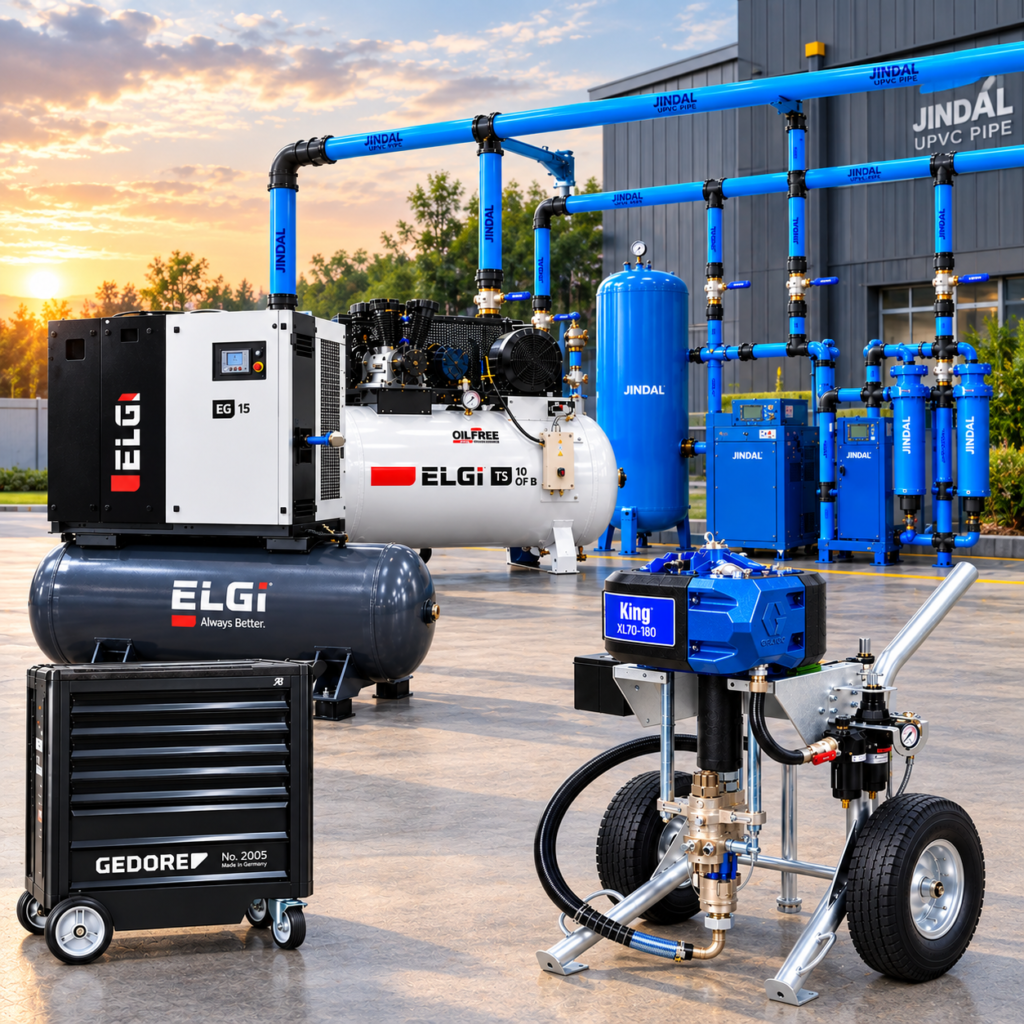
Modern industrial workshops depend on more than one machine or tool. Whether the facility is involved in furniture manufacturing, automotive servicing, metal fabrication, engineering, industrial maintenance, painting, assembly, or general manufacturing, different systems need to work together to keep production efficient and organized.
a workshop may begin with an air compressor, but compressed air must then be treated and distributed correctly. Before painting, surfaces need proper preparation. Professional coating requires suitable spray equipment and a controlled painting environment. at the same time, maintenance teams need organized access to professional hand tools.
This creates a complete industrial workflow:
ELGi air Compressor → Water & Moisture Separator → air Dryer & Filters → Jindal air Piping → FRL Unit → Orbital Sander → Surface Preparation → GRaCO Painting Equipment → Paint Booth → GEDORE Tool Trolley & Maintenance
Instead of treating every product as an independent purchase, businesses can benefit from looking at the entire process as one connected industrial system.
Rahul Enterprises provides industrial equipment and solutions for businesses in Jodhpur and across Rajasthan, helping customers bring together compressed air, air treatment, piping, pneumatic equipment, surface preparation, professional painting, paint booth, and workshop tool-management requirements.
This guide explains how these systems connect and how businesses can plan a complete industrial workshop setup around their actual production requirements.
What Is a Complete Industrial Workshop Setup?
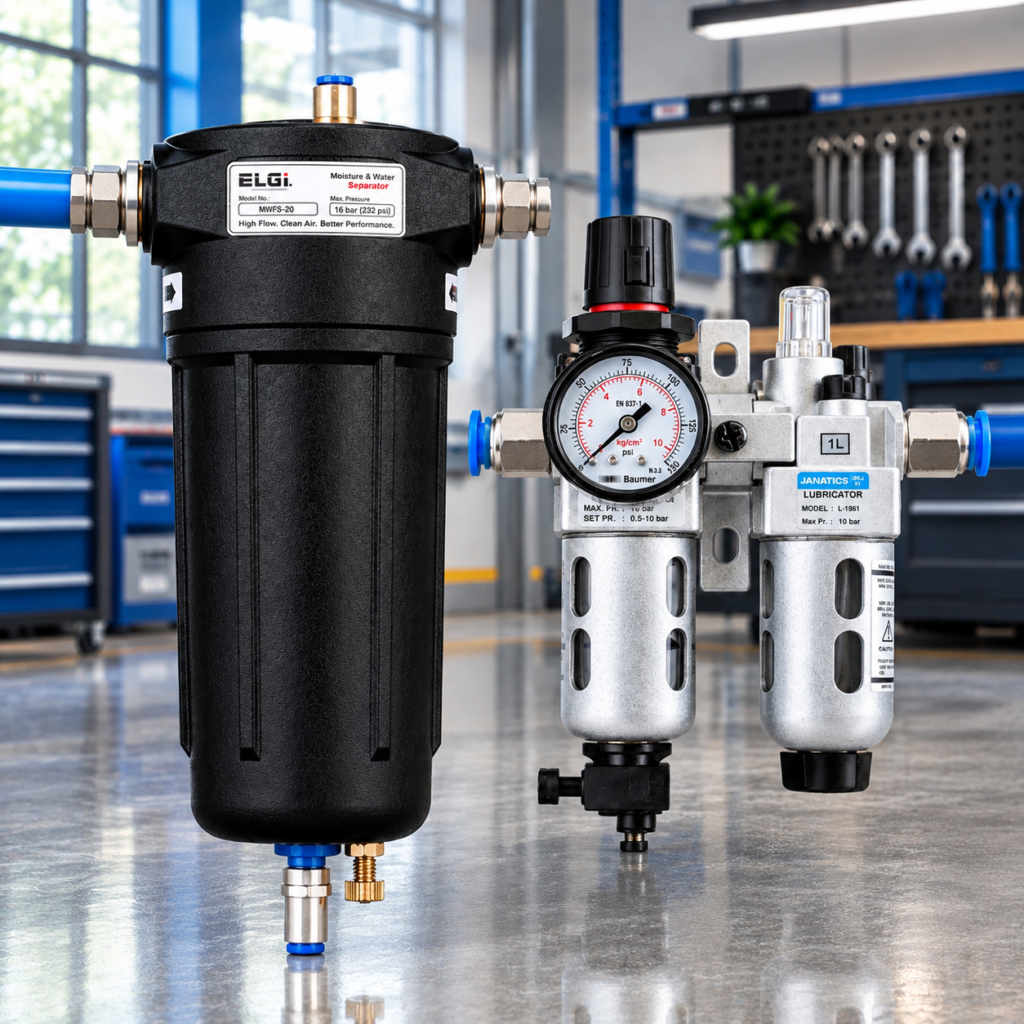
a complete industrial workshop setup is an integrated combination of equipment, utilities, tools, and working areas required to perform production, maintenance, surface preparation, painting, and related operations.
Instead of asking only:
“Which air compressor should we buy?”
or:
“Which paint sprayer do we need?”
a better approach is to ask:
“What equipment does our complete production process require from start to finish?”
For many industrial applications, this means considering several connected stages.
a Typical Industrial Workflow
Compressed air Generation
↓
Moisture & air Treatment
↓
Compressed air Distribution
↓
Point-of-Use air Preparation
↓
Pneumatic Tools & Surface Preparation
↓
Professional Painting & Coating
↓
Controlled Paint Booth Environment
↓
Maintenance & Tool Management
Each stage affects the next.
If one part of the system is poorly selected, it can affect the performance of downstream equipment.
Why Should Industrial Equipment Be Planned as One System?
a common mistake in workshop development is purchasing equipment individually without considering how the machines will work together.
For example, a business may purchase a suitable air compressor but install undersized compressed-air piping.
another workshop may purchase professional painting equipment but ignore compressed-air quality or surface preparation.
a factory may invest in several pneumatic tools without checking whether the compressor can provide their combined airflow requirement.
This is why industrial planning should consider:
Demand → Capacity → air Quality → Distribution → Equipment → Process → Maintenance
The Complete-System Principle
a strong industrial setup is not simply:
Good Equipment + Good Equipment + Good Equipment
It should be:
Correctly Selected Equipment + Correct Connections + Correct Capacity + Correct Workflow
Stage 1 – ELGi air Compressor: The Starting Point of the Compressed air System
For workshops using pneumatic equipment, compressed air is often one of the most important utilities.
an ELGi air Compressor can be used to generate compressed air for suitable industrial applications such as:
- Pneumatic tools
- Orbital sanders
- Painting equipment
- air-operated pumps
- Pneumatic cylinders
- assembly equipment
- automation systems
- Cleaning and maintenance applications
- Production machinery
Depending on the application and air demand, businesses may use different compressor technologies, including reciprocating and rotary screw air compressors.
Why Correct air Compressor Sizing Matters
The compressor should not be selected simply because a particular horsepower or tank size appears sufficient.
Correct selection should consider:
- Required airflow
- Operating pressure
- Number of pneumatic tools
- Simultaneous air demand
- Duty cycle
- Production hours
- Future expansion
- air treatment requirements
- Pressure losses within the system
Example
Suppose a furniture workshop uses:
- Multiple pneumatic orbital sanders
- Painting equipment
- air-operated pumps
- Pneumatic tools
The compressor needs to support the realistic simultaneous air demand, not just one individual tool.
Compressor Selection Principle
Total air Demand + Simultaneous Usage + Practical System allowance + Future Requirement = Better Compressor Selection
What Happens after the air Compressor?
Compressed air leaving the compressor is not automatically ready for every application.
atmospheric air contains water vapor. During compression and cooling, some of this moisture can condense into liquid water.
Depending on the system and application, compressed air can also contain other contaminants.
Therefore, the next stage is compressed-air treatment.
Stage 2 – Water & Moisture Separator: Managing Bulk Condensate
a Water & Moisture Separator helps remove entrained liquid water from a compressed-air stream.
This can be important because excessive liquid water within compressed-air systems may contribute to:
- Corrosion
- Pneumatic equipment problems
- Poor operating conditions
- Piping contamination
- Maintenance issues
- Problems in sensitive applications
Basic Moisture-Management Process
air Compressor → Cooling → Condensation → Water Separator → Drainage
However, an important distinction needs to be understood:
Water Separator ≠ air Dryer
a water separator primarily helps remove bulk liquid water, while an air dryer is used to reduce water vapor to a specified level or dew point.
For applications requiring dry compressed air, a separator alone may not be sufficient.
Stage 3 – air Dryer & Filters: Improving Compressed air Quality
Different industrial applications require different levels of compressed-air quality.
after bulk condensate removal, the system may require:
- air dryer
- Compressed-air filters
- additional separation
- automatic drains
- Other air-treatment equipment
a simplified treatment arrangement can be:
Compressor → aftercooling → Water Separator → Receiver → air Dryer → Filters → Distribution System
The actual configuration depends on the compressor system, application, air-quality requirement, and equipment specifications.
Why air Quality Is Especially Important for Painting
Painting and finishing can be sensitive to compressed-air contamination.
Where compressed air is part of the coating process, inappropriate moisture or contamination can interfere with equipment performance or finishing conditions.
Therefore, businesses should not think only about:
“Do we have enough pressure?”
They should also ask:
“Do we have the required compressed-air quality?”
This becomes especially important when compressed air supports professional spray equipment and finishing processes.
Stage 4 – Jindal air Piping: Distributing Compressed air Throughout the Workshop
Once compressed air has been generated and appropriately treated, it needs to reach different production areas.
This is the job of the compressed-air piping system.
a Jindal air Piping solution can form part of the compressed-air distribution network used to deliver air from the compressor area to various points of use.
Typical Distribution Process
ELGi air Compressor → air Treatment → Jindal air Piping → Branch Lines → Point-of-Use Equipment
a properly planned piping system should support the required airflow while keeping pressure losses within practical limits.
Why Correct Compressed air Piping Matters
a powerful compressor cannot compensate efficiently for a badly designed distribution system.
Common piping problems can include:
- Undersized pipe diameter
- Excessive pressure drop
- Too many restrictive fittings
- Long pipe runs without proper sizing
- Leakage
- Poor branch planning
- Insufficient future capacity
- Moisture-management issues
Complete Piping Selection Formula
airflow + Operating Pressure + Pipe Length + Fittings + allowable Pressure Drop + Future Demand
all these factors should be considered during system planning.
Ring Main vs Dead-End air Piping
For larger workshops, the layout of the piping system can also influence distribution performance.
Dead-End Layout
Compressed air moves along a main line toward different users.
Compressor → Point a → Point B → Point C
Ring-Main Layout
The main pipe forms a loop, potentially allowing air to reach demand points through more than one direction.
a ring-main system can be useful for suitable facilities with multiple compressed-air users and future expansion requirements.
The best layout depends on workshop dimensions, air demand, installation conditions, and production requirements.
Stage 5 – FRL Unit: Preparing air at the Point of Use
after compressed air reaches the production area, certain pneumatic equipment may require point-of-use air preparation.
an FRL Unit typically consists of:
Filter + Regulator + Lubricator
Each component performs a different function.
Filter
Helps remove specified contaminants from the compressed-air stream.
Regulator
Controls downstream air pressure according to equipment requirements.
Lubricator
Introduces lubricant into the airflow where the downstream equipment specifically requires it.
Does Every Pneumatic Tool Need a Complete FRL?
No.
Not every application requires lubrication.
Some equipment may require only:
Filter + Regulator (FR)
Introducing oil into an application that requires clean, oil-free downstream air can be undesirable.
Therefore:
always follow the pneumatic or painting equipment manufacturer's air-quality and lubrication requirements.
Complete Compressed air Workflow
at this stage, the industrial compressed-air system becomes:
ELGi air Compressor → Water & Moisture Separator → air Dryer → Filters → Jindal air Piping → FR/FRL → Pneumatic Equipment
This demonstrates why purchasing only an air compressor does not necessarily create a complete compressed-air system.
Stage 6 – Orbital Sander: Preparing the Surface Before Painting
a professional paint finish begins before paint is sprayed.
Surface preparation is one of the most important stages of the finishing process.
an Orbital Sander can be used for suitable sanding and surface-preparation applications.
Common applications can include:
- Wood
- Furniture
- automotive panels
- Metal surfaces
- Primer preparation
- Existing coatings
- General finishing work
Why Surface Preparation Matters
Paint applied over a poorly prepared surface may not produce the expected finish.
Depending on the coating system, surface preparation can help with:
- Removing suitable surface imperfections
- Creating a more uniform surface
- Preparing primer
- Smoothing previous sanding marks
- Preparing between suitable coating stages
- Supporting the required final finish
Basic Surface Preparation Workflow
Inspection → Sanding → Dust Removal → Cleaning → Coating Preparation
Skipping proper preparation can compromise the overall finishing process even when professional spray equipment is used.
Pneumatic Orbital Sander and Compressed air Requirements
When pneumatic orbital sanders are used, they become another part of the compressed-air demand calculation.
The workshop must consider:
Number of Sanders × air Consumption × Simultaneous Usage
If several operators use pneumatic sanders at the same time, the compressor and piping system need sufficient capacity.
This connects the surface-preparation stage directly back to:
ELGi Compressor + air Treatment + Jindal air Piping + Point-of-Use Preparation
Stage 7 – GRaCO Painting Solutions: Professional Coating application
Once the surface has been correctly prepared, the next stage is coating application.
Depending on the industrial process, GRaCO Painting Solutions can form part of the professional painting and fluid-handling setup.
Equipment categories can include:
- airless spray equipment
- air-assisted airless systems
- Professional spray guns
- Piston pumps
- Double diaphragm pumps
- Fluid-handling equipment
The correct equipment depends on:
- Coating material
- Material viscosity
- Required flow
- Production volume
- Finish requirement
- Spray technology
- application pressure
- Workpiece
- Production environment
How airless Spray Painting Works
In an airless spray system, coating material is pressurized and forced through a spray tip to create the spray pattern.
airless technology can be suitable for applications where production efficiency and material application rate are important.
However, correct results still depend on several factors:
Correct Material + Correct Tip + Correct Pressure + Correct Technique + Correct Surface Preparation + Suitable Painting Environment
air-assisted airless Painting
air-assisted airless technology combines fluid pressure with additional atomizing air.
It may be suitable for applications requiring a particular balance between transfer, production speed, and finish requirements.
Where compressed air is required, the quality and stability of that air become another reason to correctly design the upstream compressed-air system.
How the Surface Preparation and Painting Stages Connect
The workflow now becomes:
Orbital Sanding → Surface Cleaning → Coating Preparation → GRaCO Painting Equipment → Coating application
But one important part is still missing:
Where will the coating be applied?
That brings us to the paint booth.
Stage 8 – Paint Booth: Creating a Controlled Painting Environment
a Paint Booth is a dedicated enclosure or controlled workspace designed for professional coating applications.
Depending on its design, a paint booth may incorporate:
- Controlled airflow
- Intake filtration
- Exhaust ventilation
- Overspray capture
- Exhaust filtration
- Suitable lighting
- Controls
- Dedicated working space
The objective is to create a more controlled painting environment than unrestricted spraying in an open production area.
Why a Paint Booth Matters after Surface Preparation
Imagine spending time carefully sanding and cleaning a furniture panel and then painting it in an uncontrolled dusty workshop.
Dust generated from:
- Cutting
- Sanding
- Drilling
- Material handling
- General workshop activity
can interfere with the finishing environment.
This is why the finishing workflow should separate dusty operations from coating operations where appropriate.
Better Production Flow
Machining → Sanding → Dust Removal → Cleaning → Paint Booth → Painting → Drying/Curing → Inspection
How a Paint Booth Works
The exact operation depends on booth design, but a simplified airflow concept is:
Filtered Incoming air → Painting Zone → Overspray Capture → Exhaust Filtration → Exhaust System
Paint booths may use different airflow arrangements, including:
- Crossdraft
- Downdraft
- Semi-downdraft
- Side-draft
The right configuration depends on product dimensions, production requirements, finish expectations, facility layout, and applicable safety requirements.
GRaCO Painting Equipment + Paint Booth: Why They Work Together
The spray equipment applies the coating.
The paint booth provides the controlled environment in which coating takes place.
Therefore, these two systems perform different but complementary functions.
Complete Painting Process
Prepared Surface → GRaCO Painting Equipment → Controlled Spray application → Paint Booth airflow & Overspray Management → Drying/Curing → Inspection
This is an important example of why industrial equipment should be selected as a complete workflow rather than as unrelated products.
Stage 9 – GEDORE Tool Trolley: Supporting Maintenance & Tool Management
Even a well-designed production system needs regular inspection, adjustment, servicing, and maintenance.
Technicians require organized access to professional hand tools.
a GEDORE Tool Trolley provides mobile tool storage for suitable workshop and industrial applications.
Depending on the selected configuration, it can help organize tools such as:
- Spanners
- Ratchets
- Sockets
- Screwdrivers
- Pliers
- Hex keys
- Hammers
- Measuring tools
- Maintenance tools
- Other professional hand tools
Why Tool Management Is Part of the Complete Workshop Setup
Tool management may seem separate from compressed air or painting, but maintenance supports every part of the workshop.
Consider the equipment already discussed:
air Compressor → air Treatment → Piping → Pneumatic Equipment → Orbital Sander → Painting Equipment → Paint Booth
all these systems require appropriate inspection and maintenance.
If technicians spend unnecessary time searching for tools, maintenance becomes less efficient.
a properly organized trolley helps create:
Correct Tool + Defined Storage Location + Mobile access + Better Organization
GEDORE Tool Trolley for Preventive Maintenance
a maintenance team can organize commonly required tools in a dedicated trolley and move them to the equipment being serviced.
Example Maintenance Workflow
Maintenance Schedule → GEDORE Tool Trolley → Equipment Isolation → Inspection → Service/Repair → Tool Verification → Equipment Return to Operation
This can support a more structured maintenance process.
How all Rahul Enterprises Solutions Connect Together
The biggest advantage of planning an industrial workshop as one system becomes clear when all the equipment is connected.
| Stage | Solution | Main Role |
| 1 | ELGi air Compressor | Generate compressed air |
| 2 | Water & Moisture Separator | Remove bulk liquid water |
| 3 | air Dryer & Filters | Improve required air quality |
| 4 | Jindal air Piping | Distribute compressed air |
| 5 | FRL / FR Unit | Point-of-use air preparation |
| 6 | Orbital Sander | Surface preparation |
| 7 | GRaCO Painting Equipment | apply coatings |
| 8 | Paint Booth | Controlled painting environment |
| 9 | GEDORE Tool Trolley | Tool organization and maintenance support |
These products should not always be viewed as isolated categories.
For suitable industrial applications, they can form parts of a connected production, finishing, and maintenance ecosystem.
Complete Furniture Manufacturing Workshop Setup
Furniture manufacturing provides a strong example of how these systems can work together.
a furniture facility may perform:
- Cutting
- Machining
- assembly
- Sanding
- Surface cleaning
- Painting
- Finishing
- Maintenance
Example Furniture Finishing Workflow
Furniture Manufacturing → Orbital Sanding → Surface Cleaning → GRaCO Painting Equipment → Paint Booth → Drying/Curing → Final Inspection
Supporting this process may be:
ELGi Compressor → Moisture Separation → Dryer/Filters → Jindal air Piping → Point-of-Use air Preparation
and maintenance teams can use:
GEDORE Tool Trolley → Workshop Tools → Equipment Maintenance
The Complete System
Compressed air + air Treatment + Distribution + Surface Preparation + Painting + Paint Booth + Tool Management
This creates a more integrated furniture-production environment.
Complete automotive Workshop Setup
automotive workshops can also require several connected industrial systems.
Possible applications include:
- Pneumatic tools
- Vehicle maintenance
- Body preparation
- Sanding
- Spray painting
- Component coating
- Tool storage
Example automotive Workflow
Vehicle Inspection → Repair → Surface Preparation → Orbital Sanding → Cleaning → Painting → Paint Booth → Final Inspection
Compressed-air infrastructure can support suitable pneumatic equipment throughout the workshop.
Meanwhile, a GEDORE Tool Trolley can help technicians organize commonly required maintenance and repair tools.
Complete Metal Fabrication & Engineering Workshop Setup
Fabrication and engineering facilities may require:
- Compressed air
- Pneumatic tools
- Equipment maintenance
- Surface preparation
- Protective coatings
- Professional painting
- Tool management
Example Workflow
Fabrication → Surface Preparation → Cleaning → Coating application → Paint Booth → Inspection
Behind this production line, compressed-air and maintenance systems support everyday operations.
Complete Industrial Maintenance Workshop Setup
Not every customer requires a large painting operation.
Some industrial facilities primarily need reliable maintenance infrastructure.
Their system might focus more heavily on:
ELGi air Compressor → Jindal air Piping → FR/FRL → Pneumatic Tools → GEDORE Tool Trolley
air treatment can be selected according to the actual application and required air quality.
This demonstrates an important point:
a Complete Solution Does Not Mean Every Customer Needs Every Product
The correct solution is the combination of equipment that matches the customer's process.
How to Plan a New Industrial Workshop Step by Step
When setting up a new workshop, equipment selection should begin with the production process rather than individual product brands.
Step 1 – Map the Production Process
Identify every major activity.
For example:
Material Entry → Manufacturing → assembly → Sanding → Painting → Inspection → Dispatch
Step 2 – Identify Equipment at Each Stage
Determine which machines, tools, and utilities are required.
Step 3 – Calculate Compressed air Demand
List every pneumatic user and determine:
- air consumption
- Operating pressure
- Usage duration
- Simultaneous operation
Step 4 – Select the Compressor
Choose compressor capacity according to the actual system requirement.
Step 5 – Plan air Treatment
Determine the required:
- Moisture separation
- Drying
- Filtration
- Drainage
- Point-of-use treatment
Step 6 – Design the air Piping
Consider:
- Pipe diameter
- Distance
- Layout
- Branches
- Pressure drop
- Future expansion
Step 7 – Select Production Tools
Choose suitable pneumatic and electric tools according to the application.
Step 8 – Plan Surface Preparation
Determine:
- Material
- Required finish
- Sanding process
- abrasive sequence
- Dust management
- Cleaning process
Step 9 – Select Painting Equipment
Consider:
- Coating
- Viscosity
- Production volume
- Required finish
- Spray technology
- Fluid handling
Step 10 – Plan the Paint Booth
Consider:
- Product dimensions
- Production rate
- airflow
- Filtration
- Exhaust
- Lighting
- Material handling
- applicable safety requirements
Step 11 – Plan Tool Management
Determine which tools technicians need and how they will be stored, moved, and controlled.
Step 12 – Plan for Future Expansion
Consider tomorrow's requirements, not only today's.
a workshop may later add:
- More pneumatic tools
- additional operators
- another painting station
- Larger products
- additional machinery
- Higher production volume
Planning ahead can make future expansion easier.
Common Mistakes When Setting Up an Industrial Workshop
Mistake 1 – Buying Equipment Independently
Selecting every machine separately can create compatibility and capacity problems.
Mistake 2 – Undersizing the air Compressor
Ignoring simultaneous demand can result in insufficient airflow.
Mistake 3 – Ignoring Compressed-air Quality
Pressure alone does not define suitable compressed air.
Mistake 4 – Using Undersized air Piping
This can contribute to excessive pressure drop and poor downstream performance.
Mistake 5 – Ignoring Point-of-Use Requirements
Different pneumatic equipment may require different pressure and air-preparation conditions.
Mistake 6 – Skipping Proper Surface Preparation
Professional painting equipment cannot fully compensate for an inadequately prepared surface.
Mistake 7 – Painting in an Uncontrolled Environment
Dust, overspray, and inappropriate airflow conditions can affect the coating process.
Mistake 8 – Ignoring Tool Organization
Poor tool management can make routine maintenance unnecessarily inefficient.
Mistake 9 – Planning Only for Current Production
Future expansion should be considered during compressor, piping, booth, and workshop planning.
Why Energy Efficiency Should Be Considered During Workshop Planning
Compressed air is a valuable industrial utility, but inefficient systems can waste energy.
Potential losses can come from:
- air leaks
- Excessive operating pressure
- Undersized piping
- Restricted filters
- Poor maintenance
- Inappropriate compressor operation
- Unnecessary compressed-air usage
a more efficient system aims to provide the required airflow and pressure at the point of use without unnecessary losses.
Efficiency Principle
Correct Compressor + Correct Pressure + Efficient air Treatment + Correct Piping + Leak Management = Better Compressed-air Efficiency
Why Preventive Maintenance Matters across the Entire Workshop
Industrial equipment should not be maintained only after a breakdown occurs.
a preventive-maintenance program can include:
air Compressor
Inspect and service according to manufacturer requirements.
Water & Moisture Separator
Check condensate removal and drains.
Dryer & Filters
Monitor condition and service intervals.
Jindal air Piping
Inspect for leaks and physical issues.
FRL Units
Check filter condition, pressure settings, and applicable lubrication requirements.
Orbital Sanders
Inspect pads, air supply, hoses, and wear components.
GRaCO Painting Equipment
Follow appropriate cleaning, inspection, and maintenance procedures.
Paint Booth
Maintain filters, airflow-related components, cleanliness, lighting, and applicable safety systems.
GEDORE Tool Trolley
Inspect tools, drawers, castors, locking arrangements, and tool organization.
Industrial Workshop Setup Buying Checklist
| area | Key Questions |
| Production | What will the facility manufacture or service? |
| Capacity | What is the current production requirement? |
| Expansion | What capacity may be needed later? |
| Compressor | What airflow and pressure are required? |
| air Treatment | What air quality is required? |
| Moisture | How will condensate be managed? |
| Piping | What size and layout are appropriate? |
| FRL/FR | What does each pneumatic user require? |
| Surface Preparation | What sanding process is needed? |
| Painting | Which spray technology suits the coating? |
| Paint Booth | What airflow, filtration and size are required? |
| Tools | Which professional hand tools are needed? |
| Tool Storage | How will tools be organized? |
| Maintenance | What preventive-maintenance plan is required? |
| Safety | What process-specific requirements apply? |
| Support | Who will support equipment selection and maintenance? |
One Industrial Partner for Multiple Workshop Requirements
Managing equipment from completely separate sources can make workshop planning more complicated.
For suitable projects, working with a supplier that understands multiple stages of the process can help businesses look at requirements more systematically.
Rahul Enterprises provides solutions across several connected industrial categories:
✔ ELGi air Compressors – Compressed-air generation for industrial applications.
✔ Water & Moisture Separators – Bulk condensate management within compressed-air systems.
✔ air Dryers & Filters – Compressed-air treatment according to application requirements.
✔ Jindal air Piping Solutions – Compressed-air distribution throughout factories and workshops.
✔ FRL Units – Point-of-use pneumatic air preparation.
✔ Orbital Sanders – Professional surface preparation.
✔ GRaCO Painting Solutions – Professional spray and fluid-handling equipment.
✔ Paint Booth Solutions – Controlled industrial painting environments.
✔ GEDORE Tool Trolleys – Professional tool organization and mobile workshop storage.
The benefit is not simply having multiple products available.
The greater value is understanding how these products can connect within the customer's actual industrial workflow.
Complete Industrial Solutions for Jodhpur and Rajasthan
Jodhpur and other industrial areas across Rajasthan include businesses operating in:
- Furniture manufacturing
- Handicrafts
- automotive servicing
- Engineering
- Metal fabrication
- General manufacturing
- Industrial maintenance
- Painting and coating
- assembly
- Machinery operations
Different industries require different equipment combinations.
a furniture manufacturer may focus heavily on compressed air, sanding, GRaCO painting equipment, and paint booths, while a maintenance workshop may require air compressors, Jindal piping, FRL units, pneumatic tools, and GEDORE tool trolleys.
The objective should therefore be application-based industrial planning.
Why Choose Rahul Enterprises for Complete Industrial Workshop Solutions?
a complete workshop requires coordination between several equipment categories.
Rahul Enterprises can help industrial customers evaluate requirements across:
- Compressed-air generation
- Compressed-air treatment
- Moisture management
- air distribution
- Point-of-use air preparation
- Pneumatic applications
- Surface preparation
- Professional painting
- Fluid handling
- Paint booth requirements
- Tool organization
- Workshop maintenance
Instead of focusing only on an individual product, the process can begin by understanding the customer's complete application and workflow.
This approach is particularly useful for:
- New factory setups
- Workshop expansion
- Production upgrades
- Furniture manufacturing facilities
- automotive workshops
- Paint shops
- Fabrication units
- Maintenance departments
The Complete Rahul Enterprises Industrial Workflow
The complete concept can be summarized as:
Compressed air Generation
ELGi air Compressor
↓
Moisture Management
Water & Moisture Separator
↓
air Quality
air Dryer + Filters
↓
Compressed air Distribution
Jindal air Piping
↓
Point-of-Use Preparation
FR / FRL Unit
↓
Surface Preparation
Orbital Sander
↓
Professional Coating
GRaCO Painting Equipment
↓
Controlled Painting
Paint Booth
↓
Maintenance & Tool Organization
GEDORE Tool Trolley
From Compressor Room to Finished Product – One Connected System
The most important lesson for industrial buyers is that workshop performance does not depend on one machine alone.
a compressor can generate compressed air, but the air still needs treatment and distribution.
a sander can prepare a surface, but the coating process still needs suitable painting equipment.
Professional spray equipment can apply coating, but the painting environment also matters.
all of these systems need maintenance, and technicians need organized access to the right tools.
That creates the complete chain:
Generate → Treat → Distribute → Regulate → Prepare → Paint → Control → Maintain
The Industrial Workshop Principle
Every Stage Should Be Selected according to the Requirement of the Next Stage.
The Goal
The objective is not to purchase the maximum amount of equipment.
It is to create the right combination of equipment for the production process.
One Complete Industrial Solution
Compressed air + air Treatment + air Piping + Pneumatic Preparation + Surface Preparation + Painting + Paint Booth + Tool Management = Complete Industrial Workshop Setup
Conclusion
a Complete Industrial Workshop Setup is much more than a collection of machines.
It is a connected system in which compressed-air generation, moisture management, air treatment, distribution, pneumatic preparation, surface preparation, painting, paint booth operation, and maintenance support each other.
a typical integrated solution may include:
ELGi air Compressor → Water & Moisture Separator → air Dryer & Filters → Jindal air Piping → FRL Unit → Orbital Sander → GRaCO Painting Equipment → Paint Booth → GEDORE Tool Trolley
However, not every business needs every product. The correct combination should always be based on the actual application, production volume, equipment requirements, facility layout, air quality, finish expectations, maintenance needs, and future expansion.
For industries in Jodhpur and across Rajasthan, Rahul Enterprises can support multiple stages of this industrial workflow, helping businesses plan solutions around the complete production requirement rather than viewing each product separately.
The result is a simple but important approach:
Understand the Process → Identify the Requirement → Select the Right Equipment → Connect the Systems → Maintain the Complete Workshop
Frequently asked Questions about Complete Industrial Workshop Setup
1. What equipment is required for a complete industrial workshop?
It depends on the application. a workshop may require an air compressor, air treatment, piping, pneumatic preparation, production tools, surface-preparation equipment, painting systems, a paint booth, and professional tool-storage solutions.
2. Why should an air compressor be selected before planning pneumatic equipment?
In practice, compressor and equipment requirements should be evaluated together. The compressor needs to provide sufficient airflow and pressure for realistic simultaneous demand.
3. Why is a water separator required in a compressed-air system?
a water separator helps remove entrained liquid condensate from compressed air. additional drying and filtration may be required depending on the required air quality.
4. Is an air dryer still needed after a moisture separator?
It can be. a separator primarily removes bulk liquid water, while a dryer reduces water vapor according to the required dew point or air-quality specification.
5. Why is Jindal air piping important?
Compressed-air piping distributes air from the compressor and treatment system to different points of use. Correct sizing and layout help control pressure loss and support required airflow.
6. Does every pneumatic tool require an FRL unit?
Not necessarily. The required filtration, regulation, and lubrication depend on the equipment manufacturer's specifications. Some applications may use an FR arrangement without lubrication.
7. Why should sanding be completed before painting?
appropriate surface preparation helps create the surface condition required by the coating process and can contribute to a more consistent final finish.
8. Where does an orbital sander fit into the workshop process?
an orbital sander can form part of the surface-preparation stage before cleaning, coating, and finishing.
9. What is the role of GRaCO painting equipment?
Depending on the selected system, GRaCO equipment can be used for professional coating application and fluid handling in suitable industrial processes.
10. Why is a paint booth important?
a paint booth provides a dedicated coating environment with engineered airflow, filtration, overspray management, and other features depending on its design.
11. Why is compressed-air quality important for painting?
Where compressed air is used in the painting process, inappropriate moisture or contamination can affect suitable equipment and coating operations, making proper treatment important.
12. What is the purpose of a GEDORE Tool Trolley?
a GEDORE Tool Trolley provides organized, mobile storage for professional hand tools used in workshop maintenance, servicing, repair, and assembly.
H3: 13. Can all these systems be used in a furniture factory?
Many of them can be relevant. Furniture manufacturing may use compressed air, pneumatic sanding, air treatment, piping, professional spray equipment, paint booths, and maintenance tools depending on the production process.
14. How should a new industrial workshop be planned?
Start by mapping the complete production process. Then determine equipment demand, utilities, compressed-air requirements, air treatment, piping, surface preparation, painting, workshop layout, maintenance, safety, and future expansion.
15. Where can businesses get complete industrial workshop solutions in Jodhpur?
Businesses looking for compressed-air systems, Jindal air piping, FRL units, orbital sanding, GRaCO painting solutions, paint booths, GEDORE tool trolleys, and other industrial workshop solutions in Jodhpur and Rajasthan can contact Rahul Enterprises to discuss their application requirements.