Paint Booth: Complete Guide to Types, Working, Benefits, applications & Selection
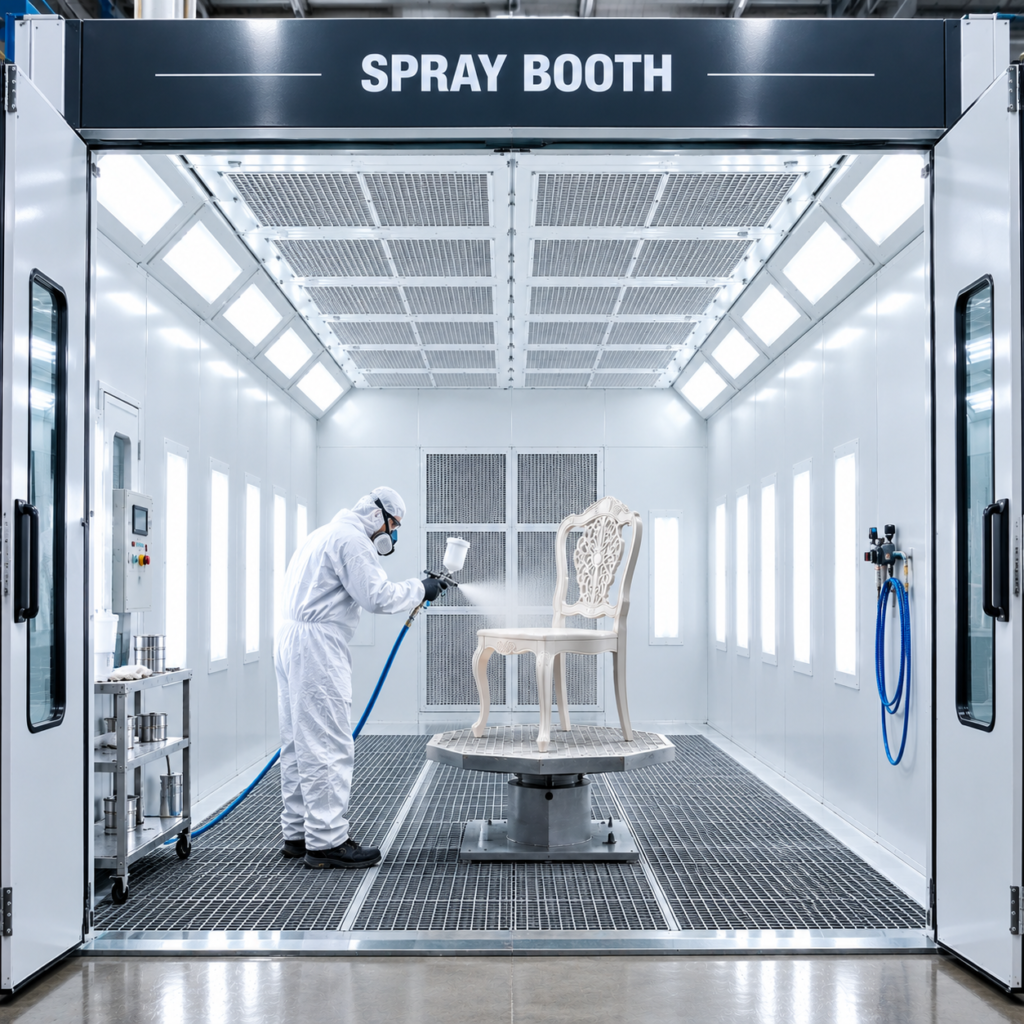
a high-quality paint finish depends on much more than the paint or spray gun being used. The environment in which painting takes place can have a major influence on finish quality, contamination control, overspray management, workflow, and operator safety.
In industrial manufacturing, furniture production, automotive refinishing, metal fabrication, and professional coating operations, uncontrolled painting can allow dust and airborne contaminants to interfere with the finishing process. Overspray also needs to be managed appropriately.
This is where a Paint Booth, also known as a Spray Booth or Painting Booth, becomes an important part of a professional finishing setup.
a properly designed paint booth creates a controlled area where coating materials can be applied while ventilation and filtration systems help manage airflow and overspray according to the booth design.
Rahul Enterprises provides industrial solutions for businesses in Jodhpur and across Rajasthan, including paint booth solutions and supporting equipment for professional painting, compressed air, surface preparation, and finishing applications.
This complete guide explains what a paint booth is, how it works, different paint booth types, airflow, filtration, applications, benefits, maintenance, safety considerations, and how to select a suitable paint booth for an industrial application.
What Is a Paint Booth?
a Paint Booth is a dedicated enclosure or controlled workspace designed for applying paint, coatings, primers, finishes, or similar materials to components or products.
Depending on its design and application, a paint booth can incorporate:
- Controlled airflow
- Exhaust ventilation
- Intake filtration
- Overspray capture
- Exhaust filtration
- Lighting
- Enclosed working space
- air replacement or make-up arrangements
- Controls and safety systems
The objective is to create a more controlled painting environment compared with spraying in an unrestricted production area.
Basic Paint Booth Process
Filtered Incoming air → Controlled Painting area → Overspray Capture → Exhaust Filtration → Exhaust System
The actual configuration depends on the booth design, coating process, applicable requirements, and production application.
Why Is a Paint Booth Important for Industrial Painting?
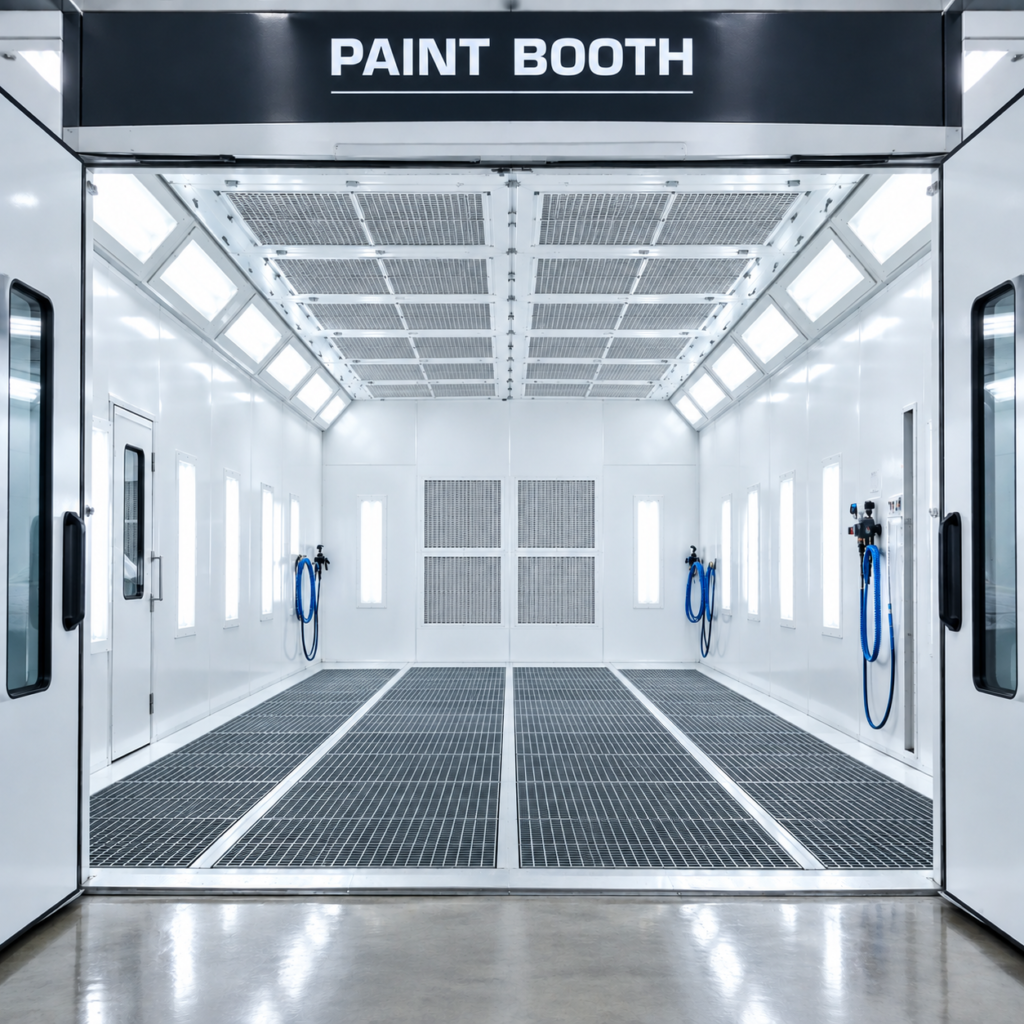
Industrial painting requires consistency.
When painting takes place in an uncontrolled area, factors such as dust, overspray, airflow, surrounding production activity, and contamination can interfere with the process.
a properly designed paint booth can help provide:
- Better control of the painting environment
- Overspray management
- Cleaner finishing conditions
- Controlled airflow
- Improved production organization
- Better separation of painting from other operations
- More consistent finishing conditions
- Safer management of coating operations when properly designed and operated
a paint booth should therefore be considered part of the complete finishing process, not simply an enclosure around a spray gun.
How Does a Paint Booth Work?
although paint booth designs vary, the basic process generally involves controlled movement of air through the painting area.
Step 1 – air Enters the Booth
air enters through an intake or make-up air arrangement.
Depending on the system, intake filters can help reduce airborne contamination entering the painting area.
Step 2 – air Moves Through the Painting Zone
airflow is directed through the area where the operator or automated system applies the coating.
Step 3 – Paint Is atomized
The selected spray equipment atomizes the coating material.
This may involve technologies such as:
- airless spray
- air-assisted airless spray
- Conventional air spray
- Other coating technologies appropriate to the process
Step 4 – Overspray Is Captured
Not all atomized coating lands on the workpiece.
The booth's airflow carries airborne overspray toward the designed capture and filtration area.
Step 5 – air Passes Through the Exhaust System
The exhaust system moves air through the appropriate filters and discharge arrangement according to the booth design.
H4: Simplified Working Principle
air Intake → Filtration → Painting Zone → Overspray Capture → Exhaust Filtration → Exhaust
Main Components of a Paint Booth
Understanding the main components helps businesses evaluate a paint booth more effectively.
1. Booth Enclosure
The enclosure creates the dedicated painting area and separates coating operations from surrounding production activities.
Its size depends on:
- Product dimensions
- Operator movement
- Material handling
- Production volume
- Spray process
- Required working clearance
2. air Intake System
The intake arrangement provides air to the booth.
Correct air supply is important because the booth's performance depends heavily on controlled airflow.
3. Intake Filters
Intake filters help reduce specified airborne contaminants entering the painting area.
Clean incoming air can be particularly important where high-quality surface finishing is required.
4. Exhaust System
The exhaust system moves contaminated air and overspray away from the painting zone.
Its design must be appropriate for the booth, coating materials, process, and applicable safety requirements.
5. Paint arrestor or Exhaust Filters
Paint arrestors or suitable exhaust filters help capture paint overspray before exhaust air continues through the system.
Filter type and replacement requirements depend on the application and booth design.
6. Lighting
Good lighting helps operators inspect:
- Surface coverage
- Spray pattern
- Coating consistency
- Defects
- Edges and corners
- Final appearance
Lighting used within or around a paint booth must be suitable for the specific installation and applicable safety requirements.
7. Control System
Depending on booth complexity, controls may manage:
- Fans
- Lighting
- airflow
- Heating where applicable
- Interlocks
- alarms
- Other process functions
Different Types of Paint Booths
Paint booths can be classified in several ways.
One important classification is based on airflow direction.
Common configurations include:
- Crossdraft Paint Booth
- Downdraft Paint Booth
- Semi-Downdraft Paint Booth
- Side-Draft Paint Booth
The best option depends on product size, required finish, floor space, production process, installation conditions, and budget.
What Is a Crossdraft Paint Booth?
In a crossdraft paint booth, air generally travels horizontally from one end of the booth toward the exhaust at the opposite end.
airflow Pattern
air Intake → Workpiece → Exhaust
Crossdraft configurations can offer a relatively straightforward airflow arrangement.
They may be considered for various industrial applications depending on the required finish and process.
Potential advantages
- Straightforward airflow concept
- Can suit various industrial applications
- Installation requirements may be simpler than some downdraft configurations
- Useful where floor excavation is undesirable, depending on design
The suitability must still be evaluated for the actual coating process.
What Is a Downdraft Paint Booth?
a downdraft paint booth generally moves filtered air from the upper area of the booth downward around the workpiece toward exhaust extraction at or near floor level.
airflow Pattern
Filtered air from above ↓ Workpiece ↓ Floor-Level Exhaust
This airflow approach can help move overspray downward and away from the painting area.
Downdraft systems are often considered where controlled finishing conditions are particularly important.
Considerations
Downdraft systems may require more complex installation arrangements depending on the exhaust design.
Factors can include:
- Floor construction
- Pit or raised-floor requirements where applicable
- Exhaust arrangement
- Installation cost
- Facility layout
What Is a Semi-Downdraft Paint Booth?
a semi-downdraft booth combines characteristics of horizontal and downward airflow.
air generally enters through the ceiling toward one section of the booth and moves diagonally toward an exhaust area.
It can provide an alternative where full downdraft installation is not practical.
What Is a Side-Draft Paint Booth?
In a side-draft arrangement, air is directed toward exhaust sections positioned along the sides or lower sides of the booth.
This can create relatively even airflow around suitable workpieces without requiring exactly the same floor arrangement as a full downdraft system.
Crossdraft vs Downdraft Paint Booth
|
Factor |
Crossdraft |
Downdraft |
|
air Direction |
Horizontal |
Top to bottom |
|
Exhaust Location |
Typically opposite end |
Floor/lower area |
|
Installation |
Often comparatively straightforward |
Can be more complex |
|
Floor Requirements |
Design-dependent |
May require specialized arrangement |
|
Finish Control |
application-dependent |
Often selected for demanding finishing |
|
Investment |
Configuration-dependent |
Often higher for complex systems |
|
Best Choice |
Depends on process |
Depends on finish and facility |
There is no single paint booth design that is automatically best for every application.
Dry Paint Booth vs Wet Paint Booth
Paint booths can also differ according to how overspray is captured.
What Is a Dry Paint Booth?
a dry paint booth generally uses dry filtration media to capture airborne paint overspray.
a simplified process is:
Painting area → Overspray → Dry Filter Media → Exhaust
Dry-filter booths are used in many industrial coating applications.
Benefits Can Include
- Straightforward filtration concept
- No water circulation system for overspray capture
- Easier suitability for certain applications
- Practical maintenance where correctly managed
Filter loading and replacement need regular attention.
What Is a Wet Paint Booth?
Certain paint booth systems use water-based overspray collection or scrubbing arrangements.
These systems are generally more complex and may be considered for specific production requirements.
Selection should consider:
- Coating volume
- Overspray load
- Production scale
- Waste handling
- Maintenance
- Water treatment
- Environmental requirements
Dry Paint Booth vs Wet Paint Booth
|
Feature |
Dry Paint Booth |
Wet Paint Booth |
|
Overspray Capture |
Dry filtration |
Water-based system, depending on design |
|
Water Requirement |
No water for primary capture |
Typically required |
|
Maintenance |
Filter management |
Water-system management |
|
Complexity |
Often simpler |
Generally more complex |
|
application |
Many industrial finishing processes |
Specific/high-volume processes |
|
Selection |
Based on process |
Based on process and overspray load |
The coating manufacturer, booth supplier, and applicable regulations should guide final selection.
Paint Booth for Furniture Manufacturing
Furniture production is one of the important applications for professional painting and finishing systems.
Products can include:
- Tables
- Chairs
- Doors
- Cabinets
- Wooden panels
- Beds
- Decorative furniture
- Modular furniture
- Interior components
- Handicraft products
Surface finish can strongly influence the final appearance and perceived quality of furniture.
a professional furniture finishing process may look like:
Wood Preparation → Orbital Sanding → Dust Removal → Coating Preparation → Paint Booth → Spray application → Drying/Curing → Inspection
Why Paint Booths Matter in Furniture Finishing
Furniture surfaces can easily be affected by airborne dust and contamination.
a controlled painting area helps separate spraying from operations such as:
- Cutting
- Sanding
- Drilling
- Material handling
- General workshop activity
This is particularly useful because sanding processes can generate dust that is undesirable during coating application.
Better Workflow
a furniture factory can create dedicated zones for:
Machining → Sanding → Cleaning → Painting → Drying → Inspection
This separation can improve production organization and finishing consistency.
Connecting Orbital Sanding with a Paint Booth
a professional finish begins before paint enters the spray gun.
Orbital sanding helps prepare the surface by creating a suitable finish for subsequent coating stages.
The workflow can be:
Orbital Sander → Surface Inspection → Dust Removal → Paint Booth → Coating application → Drying/Curing
Even high-quality painting equipment cannot fully compensate for poor surface preparation.
Paint Booth with GRaCO Painting Equipment
The paint booth creates the controlled environment, while the spray system applies the coating.
Depending on the application, GRaCO painting equipment can form part of the coating system.
Possible technologies include:
- airless spray equipment
- air-assisted airless systems
- Spray guns
- Piston pumps
- Double diaphragm pumps
- Fluid-handling equipment
Complete Painting System
Coating Material → GRaCO Pump/Spray Equipment → Spray Gun → Paint Booth → Workpiece
Equipment selection depends on coating viscosity, production rate, required finish, material compatibility, pressure, flow, and application.
airless Spray Painting Inside a Paint Booth
airless spray technology uses pressurized coating material forced through a spray tip to create the spray pattern.
It can be useful for applications requiring efficient material application.
The booth still plays an important role because overspray and airborne coating particles must be appropriately controlled.
Paint Booth + airless Equipment
Surface Preparation + Correct Coating + Suitable Spray Tip + appropriate Pressure + Controlled Booth Environment + Operator Technique
all these factors influence the finishing process.
air-assisted airless Painting in a Paint Booth
air-assisted airless technology combines fluid pressure with additional atomizing air.
It may be selected for applications where a balance between production efficiency and finish control is required.
For systems using compressed air, air quality and pressure also become important considerations.
Why Compressed air Quality Matters in Paint Booth Operations
Some spray systems and pneumatic equipment require compressed air.
Compressed air can contain:
- Water vapour
- Liquid condensate
- Particles
- Oil contamination depending on the system
For sensitive painting operations, suitable air treatment can be important.
a conceptual compressed-air system may look like:
ELGi air Compressor → Receiver → Water Separator → air Dryer → Filters → Jindal air Piping → Point-of-Use Regulation → Painting Equipment
The exact treatment depends on the required air quality and equipment specifications.
Role of Water & Moisture Separators in Painting
Moisture is undesirable in many compressed-air painting applications.
a Water & Moisture Separator helps remove entrained liquid water from the compressed-air stream.
However:
Water Separator ≠ air Dryer
Where dry compressed air is required, appropriate drying and filtration may also be necessary.
Role of FRL Units in Paint Booth Equipment
Pneumatic equipment may require filtration and pressure regulation.
an FRL Unit provides:
Filter + Regulator + Lubricator
However, lubrication must only be used where the downstream equipment specifically requires or permits it.
Oil should not automatically be introduced into air used for sensitive atomization or clean painting processes.
always follow the spray-equipment manufacturer's requirements.
Jindal air Piping for Paint Booth applications
Compressed-air piping carries treated compressed air from the compressor room to the painting area.
Correct piping design should consider:
- airflow
- Pressure
- Distance
- Pipe diameter
- Pressure drop
- Moisture management
- Number of users
- Future expansion
a restrictive distribution system can affect painting equipment even when the compressor itself has sufficient capacity.
Paint Booth for automotive Workshops
Paint booths are widely associated with automotive refinishing.
applications can include:
- Cars
- Commercial vehicles
- Vehicle components
- Body panels
- Repair parts
automotive refinishing may require controlled airflow, suitable filtration, lighting, ventilation, and drying or curing arrangements depending on the process.
Booth selection should be based on vehicle dimensions, coating materials, production volume, and applicable safety requirements.
Paint Booth for Metal Fabrication
Fabricated metal components often require protective or decorative coatings.
applications can include:
- Frames
- Cabinets
- Structural components
- Machine parts
- Fabricated assemblies
- Industrial equipment
- Metal furniture
a dedicated paint booth can help organize the coating process and manage overspray more effectively than uncontrolled open-area spraying.
Paint Booth for Manufacturing Plants
Industrial manufacturing can involve products of very different dimensions.
Therefore, booth selection must consider:
Workpiece Size + Production Volume + Material Handling + Coating Type + Spray Technology + Required Finish
a booth designed for small components may be unsuitable for large fabricated structures.
Paint Booth airflow – Why It Matters
airflow is one of the most important aspects of paint booth performance.
Too little airflow may result in inadequate control of airborne overspray.
Improper airflow patterns can also negatively affect the coating environment.
The system should therefore be engineered according to the booth configuration, dimensions, coating process, and applicable safety requirements.
Important Principle
More airflow is not automatically better.
Correct, engineered airflow is the objective.
Paint Booth Filtration System
Filters can be used at different stages.
Intake Filtration
Helps control contaminants entering the booth.
Exhaust Filtration
Helps capture overspray before air continues through the exhaust system.
Why Filter Maintenance Matters
Loaded or damaged filters can affect airflow and booth performance.
Filters should therefore be inspected and replaced according to the booth and filter manufacturer's recommendations.
Importance of Paint Booth Lighting
Operators need good visibility to evaluate the coating as it is applied.
Poor visibility can make it difficult to identify:
- Uneven coverage
- Dry areas
- Runs
- Sags
- Surface defects
- Missed edges
Lighting should be appropriately designed for the booth environment and comply with relevant requirements.
Paint Booth Size Selection
a common mistake is choosing a booth based only on the dimensions of the product.
The booth also needs suitable space for:
- Operator movement
- Spray-gun distance
- Material handling
- air movement
- Equipment
- Loading and unloading
- Maintenance access
Selection Principle
Product Dimensions + Working Clearance + Material Handling + airflow Requirements = Practical Booth Size
How to Choose the Right Paint Booth
Several factors should be evaluated before purchasing or designing a paint booth.
1. Product or Workpiece Size
Determine the maximum:
- Length
- Width
- Height
Consider future products as well.
2. Production Volume
ask:
- How many products are painted per day?
- Is production continuous or occasional?
- How long does each coating cycle take?
- Will production increase?
3. Coating Material
Identify the materials being sprayed, such as suitable:
- Paints
- Primers
- Clear coats
- Finishes
- Industrial coatings
The coating's technical and safety documentation should be considered during system design.
4. Required Finish Quality
Furniture, automotive, decorative, and general industrial coatings may have different finishing requirements.
Higher finish expectations generally require tighter process control.
5. Spray Technology
Determine whether the process uses:
- airless
- air-assisted airless
- Conventional air spray
- another coating technology
The booth and supporting utilities should suit the application.
6. airflow Configuration
Consider whether the process is best served by:
- Crossdraft
- Downdraft
- Semi-downdraft
- Side-draft
7. Filtration Requirements
Select intake and exhaust filtration according to the booth design and coating process.
8. Compressed air Requirements
Where compressed air is required, determine:
- Flow
- Pressure
- air quality
- Moisture level
- Filtration requirements
9. Facility Space
Consider:
- Booth footprint
- Loading area
- Exhaust routing
- Maintenance access
- Production flow
- Compressor and utilities
10. Safety and Compliance Requirements
Paint booth installations must consider applicable requirements relating to areas such as:
- Ventilation
- Fire safety
- Electrical equipment
- Flammable materials
- Worker exposure
- Exhaust discharge
- Environmental requirements
Qualified professionals should be involved in design, installation, and approval where required.
Paint Booth Safety Considerations
Paints, solvents, coatings, and airborne spray materials can create serious hazards depending on their composition and process.
a professional paint booth should therefore never be treated simply as a metal room with an exhaust fan.
Important considerations include:
- adequate engineered ventilation
- appropriate electrical equipment
- Fire and ignition-source control
- Proper PPE
- Grounding and static-control measures where required
- Safe coating storage and handling
- Filter maintenance
- Correct exhaust arrangement
- Safety Data Sheet requirements
- applicable local regulations
- Manufacturer instructions
Important Safety Rule
Never modify booth airflow, electrical systems, exhaust arrangements, or safety controls without qualified technical evaluation.
Common Paint Booth Problems
1. Dust in Paint Finish
Possible causes include:
- Dirty intake filters
- Poor surface cleaning
- Dusty surrounding production area
- Contaminated clothing or equipment
- airflow problems
2. Excessive Overspray
Possible factors include:
- Incorrect spray pressure
- Incorrect spray tip/nozzle
- Poor operator technique
- Excessive gun distance
- Coating setup
- airflow conditions
3. Uneven Finish
Possible causes include:
- Spray technique
- Incorrect pressure
- Material viscosity
- Spray-tip condition
- Surface preparation
- airflow
- Coating preparation
4. Runs and Sags
Possible causes include:
- Excessive material application
- Slow gun movement
- Incorrect spray distance
- Unsuitable tip/nozzle
- Coating viscosity
- application technique
5. Poor airflow
Possible causes can include:
- Loaded filters
- Fan problems
- Blocked airflow paths
- Incorrect system balance
- Maintenance issues
Qualified personnel should investigate ventilation-system problems.
Paint Booth Maintenance Guide
Regular maintenance supports booth performance and safe operation.
Routine Checks
Inspect:
- Filters
- airflow indicators where provided
- Lighting
- Doors and seals
- Booth cleanliness
- Overspray accumulation
- Controls
Periodic Maintenance
Check:
- Intake filters
- Exhaust filters
- Fan systems
- Electrical components
- Ducting
- Safety systems
- air supply
- Spray equipment
Scheduled Professional Inspection
Critical ventilation, electrical, fire-safety, and control systems should be serviced according to manufacturer requirements and applicable regulations.
Common Mistakes When Buying a Paint Booth
Mistake 1 – Selecting Only by Price
The lowest initial price may not provide the required airflow, filtration, size, safety, or production capability.
Mistake 2 – Choosing the Wrong Booth Size
Insufficient working clearance can make painting and material handling difficult.
Mistake 3 – Ignoring airflow Design
a paint booth is fundamentally an engineered ventilation system.
Mistake 4 – Ignoring Filtration Costs
Filters are recurring consumables and should be included in operating-cost planning.
Mistake 5 – Ignoring the Spray Equipment
The booth and spray system should be selected as compatible parts of the finishing process.
Mistake 6 – Ignoring Compressed-air Quality
air-operated painting equipment may require properly treated compressed air.
Mistake 7 – Ignoring Safety Requirements
This can create serious operational and compliance risks.
Paint Booth Buying Checklist
|
Factor |
What to Check |
|
application |
Furniture, automotive, metal, industrial |
|
Workpiece Size |
Maximum dimensions |
|
Production |
Daily/shift volume |
|
Coating |
Material being applied |
|
Finish |
Required surface quality |
|
Spray System |
airless, air-assisted, etc. |
|
Booth Type |
Crossdraft, downdraft, side-draft |
|
Filtration |
Intake and exhaust requirements |
|
airflow |
Engineered ventilation requirement |
|
Lighting |
Visibility and suitability |
|
Compressed air |
Pressure, flow and quality |
|
Exhaust |
Routing and system requirements |
|
Safety |
Fire, electrical and worker protection |
|
Maintenance |
Filters, fans, cleaning |
|
Expansion |
Future product/production needs |
|
Support |
Installation and technical assistance |
Complete Professional Painting Workflow
For industries seeking better finishing consistency, individual equipment should work together as a system.
Stage 1 – Surface Preparation
Use appropriate sanding and preparation equipment.
Stage 2 – Dust Removal
Clean the workpiece before coating.
Stage 3 – Compressed air Generation
Generate sufficient compressed air where required.
Stage 4 – Moisture & air Treatment
Manage condensate, moisture, and specified contaminants.
Stage 5 – air Distribution
Deliver compressed air through appropriately designed piping.
Stage 6 – Spray application
Use suitable professional painting equipment.
Stage 7 – Controlled Paint Booth Environment
apply coatings within a correctly designed and maintained booth.
The complete workflow becomes:
Orbital Sanding → Surface Cleaning → ELGi Compressed air → Water/Moisture Separation → air Treatment → Jindal air Piping → GRaCO Painting Equipment → Paint Booth → Drying/Curing → Inspection
Paint Booth Solutions from Rahul Enterprises
Rahul Enterprises supports industrial customers with solutions that can form part of a professional surface-preparation and painting system.
These can include:
✔ Paint Booth Solutions – Controlled painting environments for industrial finishing applications.
✔ GRaCO Painting Solutions – Professional spray and fluid-handling equipment.
✔ Orbital Sanders – Surface preparation for furniture, automotive, and industrial finishing.
✔ ELGi air Compressor Solutions – Compressed-air generation for suitable pneumatic and production applications.
✔ Water & Moisture Separators – Supporting bulk condensate management.
✔ FRL Units – Point-of-use air preparation where required.
✔ Jindal air Piping Solutions – Compressed-air distribution throughout industrial facilities.
Together, these solutions can support the complete process from surface preparation to final coating application.
Paint Booth Solutions in Jodhpur and Rajasthan
Jodhpur and Rajasthan have businesses across furniture manufacturing, handicrafts, fabrication, automotive, engineering, and general industrial production where professional coating systems may be required.
Businesses searching for:
- Paint Booth in Jodhpur
- Industrial Paint Booth Jodhpur
- Spray Paint Booth Jodhpur
- Furniture Paint Booth Jodhpur
- Paint Booth for Furniture Industry
- Industrial Painting Booth Rajasthan
- Spray Booth Rajasthan
- Professional Painting Solutions Jodhpur
can contact Rahul Enterprises to discuss their production and finishing requirements.
Why Choose Rahul Enterprises for Paint Booth Solutions?
Selecting a paint booth involves more than choosing an enclosure.
Rahul Enterprises can help industrial customers evaluate important application factors such as:
- Product dimensions
- Production volume
- Required finish
- Spray technology
- Coating application
- Compressed-air requirements
- Surface preparation
- air-treatment requirements
- Piping requirements
- Workflow
- Maintenance considerations
- Future production needs
This helps businesses approach painting as a complete industrial finishing process.
Final Paint Booth Selection Checklist
Before selecting a paint booth, answer these questions:
- What products will be painted?
- What is the largest workpiece?
- How much working clearance is required?
- How many products will be painted per shift?
- Which coatings will be applied?
- What finish quality is required?
- Which spray technology will be used?
- Is GRaCO spray equipment being considered?
- Is compressed air required?
- What compressed-air flow is required?
- What compressed-air quality is required?
- Which airflow configuration suits the application?
- What filtration is required?
- How will overspray be captured?
- What lighting is required?
- How will products enter and leave the booth?
- What maintenance access is needed?
- What applicable fire and electrical requirements must be met?
- What environmental requirements apply?
- Is future production expansion expected?
Conclusion
a Paint Booth is an important part of a professional industrial finishing system because it provides a dedicated environment for applying coatings while helping manage airflow, contamination, and overspray.
The right booth should not be selected based only on price or dimensions.
a professional selection process should consider:
application → Workpiece Size → Production Volume → Coating → Finish Quality → Spray Technology → airflow → Filtration → Safety → Maintenance
For furniture manufacturers, automotive workshops, fabrication units, engineering plants, and other industrial businesses, a properly designed paint booth can help create a more organized and controlled coating process.
The best results come from considering the complete finishing system:
Surface Preparation + Clean Compressed air + Efficient air Piping + Professional Spray Equipment + Controlled Paint Booth + Correct Operator Technique
Businesses looking for Paint Booth solutions in Jodhpur and Rajasthan can contact Rahul Enterprises for application-based industrial painting and finishing solutions.
Frequently asked Questions about Paint Booths
1. What is a paint booth?
a paint booth is a dedicated enclosure or controlled workspace designed for applying paint and coatings while managing airflow, overspray, and the painting environment.
2. What is the difference between a paint booth and a spray booth?
The terms are commonly used interchangeably, although specific equipment terminology may vary by application and manufacturer.
3. What are the main types of paint booths?
Common airflow configurations include crossdraft, downdraft, semi-downdraft, and side-draft booths.
4. What is a dry paint booth?
a dry paint booth generally uses dry filtration media to capture paint overspray.
5. What is a wet paint booth?
a wet booth uses a water-based overspray collection or scrubbing system, depending on its design.
6. Which paint booth is best for furniture?
The appropriate booth depends on furniture dimensions, production volume, coating type, finish requirement, available space, and spray technology.
7. Can a paint booth be used with GRaCO spray equipment?
Suitable GRaCO spray equipment can form part of an industrial paint-booth system when the equipment, coating, booth, and utilities are correctly matched.
8. Why is airflow important in a paint booth?
Engineered airflow helps manage airborne overspray and maintain appropriate conditions within the painting area.
9. Why are filters used in paint booths?
Intake filters can help control incoming contamination, while exhaust filtration helps capture overspray according to the booth design.
10. Does a paint booth require an air compressor?
The booth ventilation system itself and the painting equipment have separate utility requirements. Pneumatic spray equipment, pumps, or other devices may require compressed air.
11. Why is compressed-air quality important for painting?
Moisture and contamination in compressed air can interfere with suitable painting processes and pneumatic equipment, so appropriate air treatment may be required.
12. How often should paint booth filters be changed?
Replacement frequency depends on the filter type, coating volume, operating hours, pressure or airflow conditions, and manufacturer recommendations.
13. Can a paint booth improve paint finish quality?
a properly designed and maintained booth can provide more controlled finishing conditions, but final quality also depends on surface preparation, coating, spray equipment, operator technique, and curing.
14. What should I check before buying a paint booth?
Evaluate workpiece dimensions, production volume, coating type, required finish, spray technology, airflow, filtration, facility space, maintenance, and applicable safety requirements.
15. Where can I get a paint booth in Jodhpur?
Businesses looking for industrial paint booths, furniture paint booths, spray booths, and professional painting solutions in Jodhpur and Rajasthan can contact Rahul Enterprises to discuss their application and production requirements.